
White crust, cloudy glass, odd taste: what are you seeing?
Most people call about one of a handful of symptoms: white crust on faucets, spots on glasses, a film in the shower, a taste at the kitchen tap or a water heater that rumbles. Each has a different cause, and only some are fixed by a softener.
Crust and spots usually point to dissolved minerals, and a chlorine taste points to a carbon filter. Cloudy water that clears after a minute can be trapped air, and rust-colored water may be old iron pipes rather than the supply. Writing down what you see, and where, narrows the answer before anyone sells you a system. If one hot-side fixture is the only trouble, the cause may be a tank heater, which is a water heater repair question.
Test first, then decide
Buying equipment before you know your water is the most common and expensive mistake.
- Use a home test kit for hardness, or send a sample to a certified lab for a fuller result.
- Ask the Park Ridge Public Works department for the city's annual water quality report.
- Test at the kitchen cold tap after the water has run, not first thing in the morning.
- Note which fixtures show scale. If only the hot side does, the water heater may be the source.
- Write down the taste or smell and whether it is on hot, cold or both.
- Keep your results. A reputable installer will want to see them.
Park Ridge note: where your water comes from
Park Ridge buys all of its drinking water from the City of Chicago, which draws from Lake Michigan, according to the city's 2020 water quality report. The report lists lead and copper results at 30 sample sites, none above the action level, and advises residents to flush the tap after water has sat for several hours.
We do not quote a hardness figure for Park Ridge, because the report we have does not publish one. That means the right move is to test your own tap and ask the city for the current annual report before spending on equipment. Flushing the tap is free and takes a minute.
Softener or filter acting up?
Tell us the brand, the symptom and what the display shows.
When a softener helps, and when to skip it
A softener can help when
- A test confirms mineral-heavy water.
- Scale shortens the life of appliances or clogs fixtures.
- You have spots and crust that cleaners cannot keep up with.
- You are willing to buy salt and maintain the unit.
Do not buy one when
- The test shows low hardness.
- Your complaint is taste or chlorine, which a softener does not remove.
- You want to treat drinking water for contaminants, because a softener is not designed for that.
- Someone in the home is on a sodium-restricted diet and has not asked a doctor about softened water.
Filtration types and what each one does
Carbon filter
Reduces chlorine, taste and odor. Available under the sink, on a faucet, or on the whole house.
Reverse osmosis
A membrane system, usually under the sink, for drinking and cooking water. It has a storage tank and sends some water to the drain.
Whole-house sediment
Catches sand, rust flakes and silt before they reach fixtures and appliances. It does not soften water.
Water softener
A resin tank that exchanges calcium and magnesium for sodium or potassium and is recharged with salt.
Specialty filters
Iron, sulfur or ultraviolet units address specific problems that a test has found.
Combination systems
A whole-house filter followed by a softener is common when a test shows both sediment and minerals.
NSF/ANSI standards to look for
NSF International (nsf.org) tests and certifies treatment systems. A claim on a box is not the same as certification, so look for the mark and then verify the model on nsf.org.
| Standard | What it covers | Useful for |
|---|---|---|
| NSF/ANSI 42 | Reducing aesthetic impurities such as chlorine, taste and odor | Carbon filters for taste |
| NSF/ANSI 44 | Cation exchange water softeners regenerated with sodium or potassium chloride | Softeners |
| NSF/ANSI 53 | Reducing contaminants with a health effect | Filters for specific health-related contaminants |
| NSF/ANSI 58 | Reverse osmosis systems | Under-sink RO drinking water |
| NSF/ANSI 401 | Emerging contaminants, up to 15 listed | Added screening for drinking water |
Installation: salt, drain and bypass
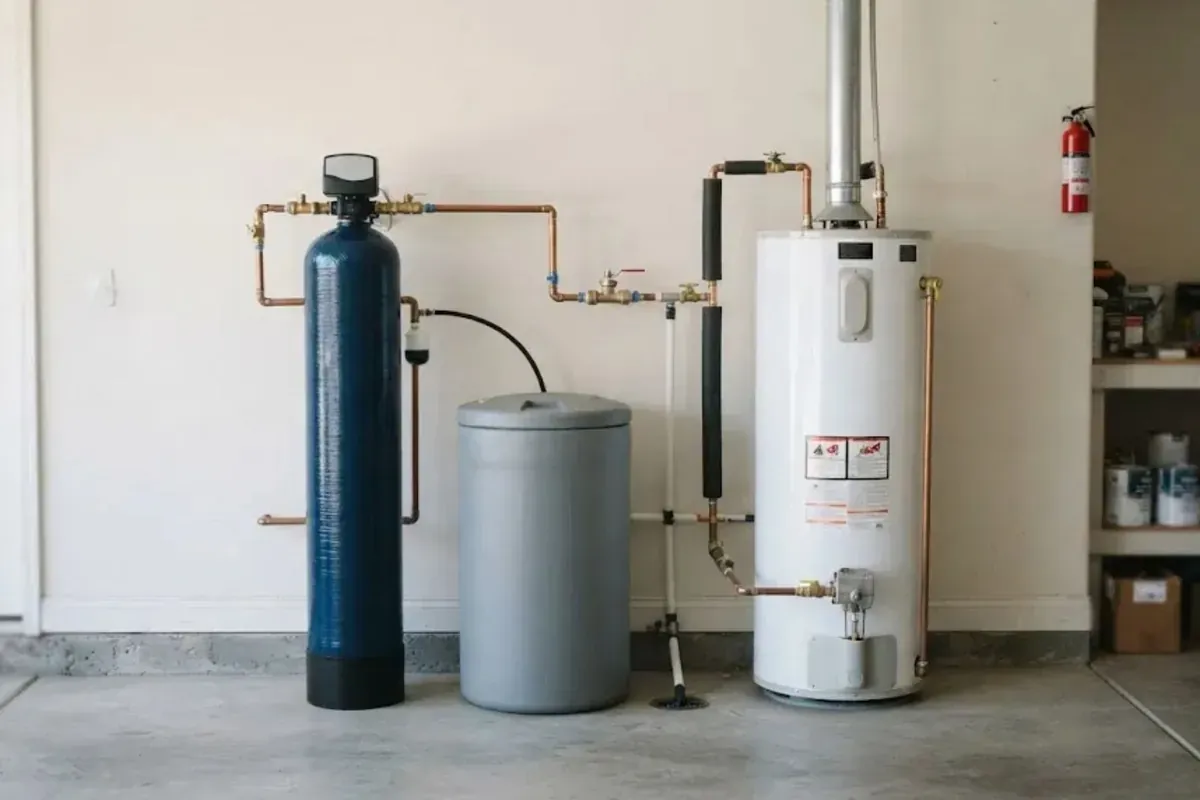
A softener needs three things nearby: a cold water line, a drain for regeneration water, and an outlet. It also needs salt, either sodium or potassium chloride per NSF/ANSI 44, stored in the brine tank, which you refill every few weeks to months. A bypass valve lets you isolate the unit for service.
The drain connection matters more than people expect. Backwash and brine must go to a drain through a proper air gap, and the route is chosen so wastewater cannot siphon back. Placement, drain and code details vary by house, so we confirm on site. Related work like new shutoffs belongs with plumbing installation.
Softener repair: valve, resin and brine tank
A softener that stops softening usually has one of a few problems. The control valve may not cycle, a motor or timer may have failed, or the injector may be plugged. Salt can bridge into a hard crust in the brine tank, leaving no brine to recharge the resin. Old resin beads lose capacity, and a cracked tank or leaking fitting needs more than a reset.
Overflow and leaks at the brine tank or drain line are the urgent ones. If a unit is running water down the drain or flooding the floor, put it on bypass or shut the supply, then call our 24/7 line.
Water conditioner repair
Some homes have a branded water conditioner rather than a plain softener, and callers often give us only a model name. Bring that model name, the age of the unit and the symptom. We read the control, check the valve and salt, and tell you whether a repair or a replacement makes more sense.
Maintenance that keeps scale and sediment away
Check the salt level monthly and break up any hard crust in the brine tank. Replace sediment cartridges and carbon filters on the schedule the maker prints on the label, since a clogged cartridge cuts pressure and a spent one stops working.
If you also have a gas or electric tankless unit, mineral buildup can be a factor in its flushing needs. Our tankless water heater page explains descaling, and water heater repair covers sediment in a standard tank.
What drives the cost of a softener or filter
A small under-sink filter and a whole-house system are very different projects. The test results shape the choice. For your real number, call our 24/7 line.
Treatment equipment is a planned upgrade, not an insurance matter. If a softener floods the floor, sudden water damage may be covered, but read your policy. Landlords should confirm who owns and maintains the unit.
Frequently asked questions
We do not state a figure because the city report we reviewed does not publish one. Test your own tap and ask Park Ridge Public Works for the annual water quality report.
They solve different problems. Scale and spots are mineral problems for a softener. Taste, odor or contaminants are filtration questions. A test tells you which.
Yes. Our dispatch line is open 24/7 and same-day appointments are offered when available.
Only if it is certified for lead reduction, for example to NSF/ANSI 53. Check the certification on nsf.org. The city report advises flushing the tap after water has sat for several hours.
NSF/ANSI 44 describes resin regenerated with sodium or potassium chloride. Check the unit's manual for the type and form it expects.
Yes. We start with a test, pick a certified system and connect it with a bypass and a proper drain.
Often. We check the valve, timer, injector and brine line first. If the resin or tank is the problem, we explain replacement before any work starts.