
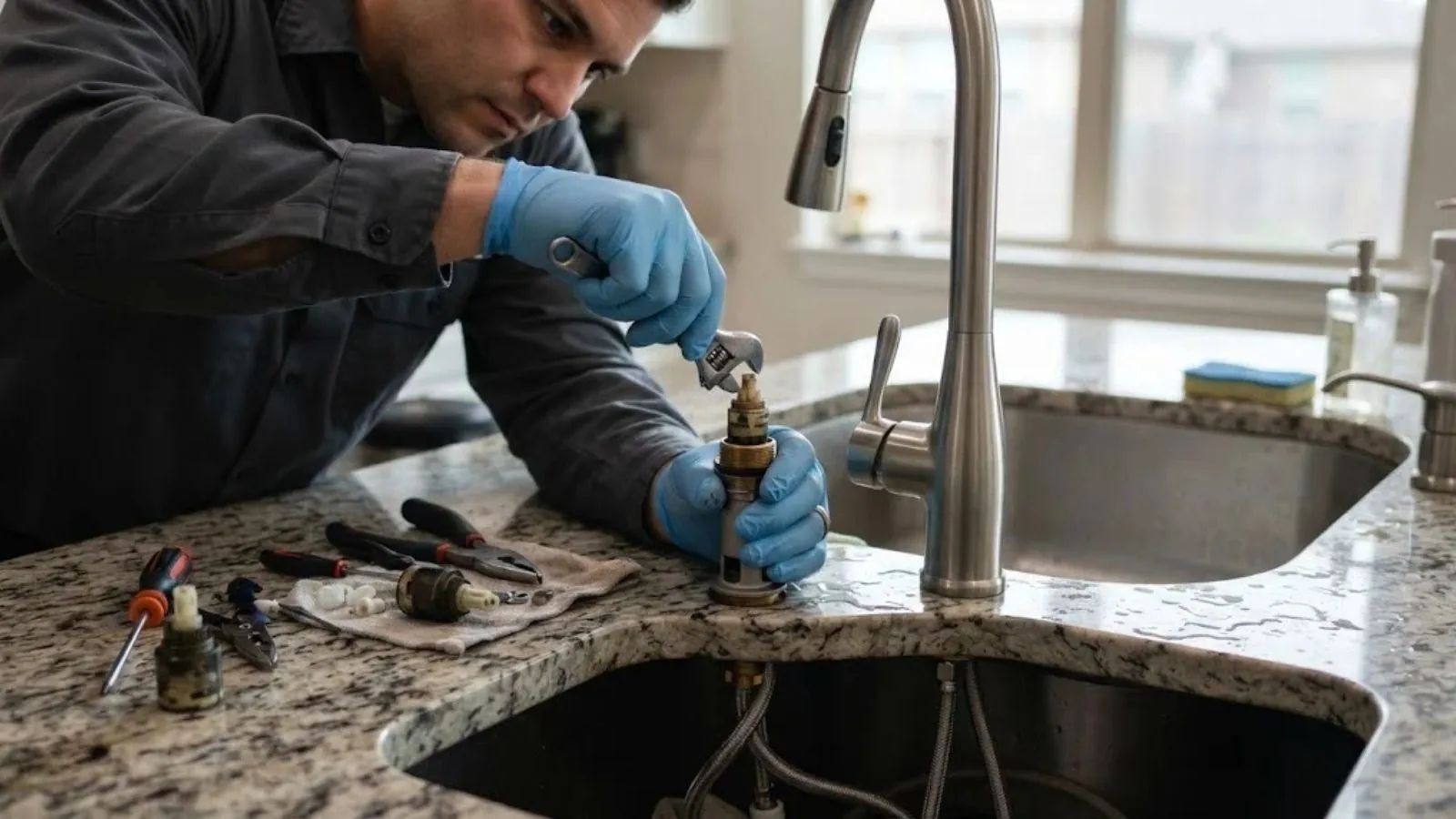
Six moments when a faucet turns into a plumber call
Faucet problems tend to show up at predictable moments. Find yours below, then read on for what to do.
A drip that never stops
A steady drip points to a worn washer, seat, O-ring or cartridge. It is the most common faucet repair, and the drip runs day and night.
Wet cabinet floor
Dampness under the sink means a supply line, an angle stop or a drain connection is weeping. A dry paper towel held to each joint shows which one.
Handle spins, water runs
A fixture that keeps flowing after you close it needs the water shut off upstream before anything else.
Spray or burst line
A braided supply line that fails can put out a lot of water fast. Treat it as an emergency.
Stiff, gritty handle
Mineral buildup or a worn cartridge makes handles hard to turn. Forcing one can snap the stem.
Cold-snap spigot
An outdoor hose bib that froze may crack inside the wall and leak only when you turn it on in spring.
Valve will not shut off or a supply line burst: act in this order
Treat uncontrolled water as an emergency, whether it comes from a cracked braided line, a snapped angle stop or a valve that spins and does nothing. Work from the nearest shutoff outward so you stop the flow with the least disruption. Our 24/7 line takes these calls at night and on weekends.
If the little valve under the sink will not turn, do not force it with pliers. A twisted stem can break and release more water. Go straight to the main valve instead.
- Turn the angle stop under the sink clockwise to close it
- If water still flows, close the main valve where the water line enters the house
- After the main is closed, open the lowest faucet in the house to drain the line
- Put a bucket and towels under the leak and move belongings out of the way
- Stay away from outlets and power strips near standing water
- Photograph the damage for your insurance claim before you clean up
Three valves between the street and your faucet
Water passes through three kinds of shutoff before it reaches a spout. The first is the angle stop, the small oval or round handle directly under a sink. Next is the main shutoff, usually near the water meter in a basement or utility room. The last is the valve at the street, which the city controls.
Old multi-turn valves wear out inside and can spin freely without closing, while newer quarter-turn ball valves are easier to trust in an emergency. Find your main valve before you need it, label it, and turn it closed and open once a year so it does not seize. A valve that moves stiffly today is the one that will not close during a burst.
Water will not stop?
Close the main valve and call our 24/7 line. We handle faucets, stops and supply lines day or night.
Cartridge, compression, ball and disc faucets: how each one wears out
Knowing the type tells a plumber which parts to bring and tells you whether a repair is realistic.
| Faucet type | How it wears out | Usual repair |
|---|---|---|
| Compression (two handles that tighten to close) | Rubber washers and seats wear, so it drips from the spout | Replace the washer and seat |
| Cartridge (single or double handle, smooth motion) | O-rings and the cartridge wear, causing drips and a loose handle | Swap the cartridge or O-rings, matched to the model |
| Ball (single handle over a rounded cap, common in kitchens) | Springs, seats and the ball wear and leak at the handle base | Replace the seals and springs or the ball |
| Ceramic disc (single handle, very smooth) | Disc seals wear or mineral buildup scratches the discs | Replace the disc cylinder |
| Pull-down kitchen sprayer | The hose, weight or diverter fails and the spray leaks or drips | Replace the hose or diverter |
Broken or burst supply valves and supply lines
A supply line is the braided or rigid hose that connects the angle stop to the faucet. The braided kind has a rubber core that ages, and the nut at either end can corrode. Failures often start at the coupling, and a line that looks fine can give way without warning.
An angle stop that drips at the stem, weeps at the nut or will not close is a separate problem. Replacing one means closing the main valve first, which is why a stuck main is the more serious case. If the main will not close either, tell us on the call so we can plan around it, and if a pipe behind the wall has also failed, see burst pipe repair.
We replace the stop and the line together, since a new stop on an old line leaves the weak link in place. Quarter-turn stops are easier to use the next time something goes wrong.
Showers, tubs and drains that share a visit
A shower valve leak usually lives behind the wall. Water that keeps coming from the showerhead after you shut it off means the cartridge or seats inside the valve are worn, while a drip at the head itself is often a washer or buildup at the arm. A wet wall or a stain on the ceiling below is a different matter and needs an access panel opened.
Tub faucet repair follows the same logic. A spout that drips usually has a worn cartridge or seat, and a spout that sprays from the shower riser as the tub fills has a diverter that is not sealing. Older tubs can need a matching cartridge that is hard to find, which sometimes tips the choice toward a new valve.
Shower and tub drains clog with hair and soap film long before the pipe itself is the problem. A strainer and a small hair tool clear the top few inches. When water backs up from the tub into a sink or toilet, the blockage is further down, and drain cleaning with a cable reaches it.
Ordinary faucet repair on a bathroom or kitchen sink follows the table above: identify the type, replace the worn cartridge or seals, and clear the aerator. A leak under a utility sink, from the supply or the trap, is fixed on the same visit.
Repair the faucet or replace it
Repair when
- The body is sound and only a cartridge, washer or seal is worn.
- Parts for your model are still sold.
- The finish is in good shape.
- The leak is at the supply line or stop, not the faucet.
Replace when
- The body is pitted, cracked or leaking from the casting.
- You have repaired the same faucet more than once.
- Parts are discontinued or hard to match.
- You want a different style, height or a pull-down sprayer.
Outdoor spigots and winter shutoff in Zone 5b
USDA hardiness maps place Park Ridge in zone 5b, where hard freezes are normal, so treat every outdoor spigot as a pipe that can crack. The University of Illinois Extension advises removing and draining all hoses from the spigots, because a hose left attached can hold water that freezes and pushes ice back toward the house.
A frost-free sillcock has a long stem that puts the valve seat inside the heated part of the wall, so the water stops where it cannot freeze. It also has to be installed with a slight downward tilt to drain. The same Extension article cautions that even frost-proof spigots can freeze, depending on how cold it gets and how well the wall is insulated.
Extension also suggests giving each spigot's supply its own shutoff with a bleeder valve, so you can close it for winter and drain the line. If a spigot cracked over the winter, it may leak only when you open it in spring, and water can spray inside the wall. Close the indoor shutoff and call us for same-day help when available.
What decides the price of a faucet or valve repair
A cartridge swap and a stuck stop behind a tiled wall are both called faucet repair, but they are very different jobs. For your real number, call our 24/7 line.
Most homeowner policies cover sudden water damage from a burst supply line, but they usually do not pay for the worn part itself or for a slow drip that went unfixed. Sewer or sump backup normally needs a separate endorsement, so check your policy and keep your photos.
Park Ridge note: who shuts off what, and who pays for which pipe
Park Ridge residents who need the water shut at the street after hours call the Police Department non-emergency line, and during business hours the Public Works Service Center takes requests (city FAQ). Closing the street valve does not stop the water bill, but it can stop a flood when your own main will not close. Know which valve you have before the night you need it.
The city maintains water meters, while the homeowner repairs the water service pipe between the buffalo box and the premises (Municipal Code 11-1-6 as quoted on the city FAQ). A leak between the street and your main is yours to fix, and water service line repair covers it.
The city's WaterSmart portal also sends leak alerts, which is handy for a slow faucet or valve leak, and leak detection can trace one that stays hidden. Bills arrive every other month, so a small leak can run a long time before the paper bill catches it.
Licensing and code for faucet work
Swapping a faucet is simple work, but the Illinois Plumbing License Law, 225 ILCS 320, still sets who may do plumbing for pay. According to the Illinois Department of Public Health, you can check any plumber's license on its online lookup before the visit.
Frequently asked questions
Yes. Our dispatch line is open 24/7 for faucets, valves and supply lines that will not shut off or have burst. Same-day appointments are available when the schedule allows for drips that can wait.
Often, yes. Close the angle stop, remove the handle, and replace the washer, O-ring or cartridge. Take the old part to the store so the new one matches. If the stop will not close or the faucet body is pitted, call a plumber.
Dry every joint under the sink, then run the water and touch a dry paper towel to each connection in turn. Wetness at the nut or hose points to the line or stop, and wetness only when the spout runs points to the faucet or drain.
Close the main valve where the water enters the house. Do not force the stuck stop, because a broken stem can release more water than the leak you started with.
Yes. Give us the unit, the fixture and the access details, and we can schedule the visits. Tenants should report leaks right away, and your lease decides who pays.
Remove and drain the hose, close the indoor shutoff to that spigot if you have one, and open the outdoor faucet to let it drain. Frost-free models still need the hose off.
Yes. EPA says a faucet dripping once per second can waste more than 3,000 gallons a year. Park Ridge bills every other month, so a drip can run a long time before you notice.