
My water bill went up and I cannot see a leak
A leak does not have to drip onto a floor to cost money. A toilet flapper that never seals, a cracked line under a floor slab, or a split pipe in a buried yard run can all waste water for weeks while every ceiling stays dry. The usual first clue is a bill that crept up with no change in how many people live in the house.
Other clues show up at home. The meter dial turns with every tap closed, a quiet room has the hiss of running water in the wall, one patch of floor feels warm, or a ceiling spot grows a brown ring. Any one of these is a reason to test, and two together mean you should call.
Park Ridge bills every other month, so a leak that starts right after a bill arrives can run for most of two months before the next one shows it. That delay is why the meter test further down this page matters more than waiting for paper.
Signs water is escaping where you cannot see it
Most hidden leaks announce themselves in more than one way. Match what you notice to the list, then read the section that fits.
Meter keeps moving
The dial or leak indicator turns with every fixture off, so water is leaving the pipes somewhere.
Bill creeps up
Use rises with no new habits. Compare several bills, not only the latest one.
Stained ceiling
A brown ring, bubbling paint, or a soft drywall seam means water is pooling above.
Warm floor spots
A hot-water line under tile or carpet can warm one patch of flooring.
Running-water sound
A faint hiss or trickle at night with everything off points to a pressurized line.
Musty smell
A persistent odor with no visible source suggests moisture behind a wall or under a floor.
Emergency leak detection: what to do right now
If water is coming through a ceiling, spreading toward the electrical panel, or running fast, treat it as an emergency. Our 24/7 line takes calls overnight and on weekends, and the next few minutes decide how much drywall and flooring survive.
- Close the main shutoff valve on the house side of the meter by turning it clockwise until it stops.
- Open one faucet at the lowest level to relieve pressure and slow a ceiling leak.
- Stay out of rooms where water reaches outlets, cords, or the panel, and shut off breakers only if you can reach them on dry floor.
- Move rugs, boxes, and furniture off wet floors and photograph the damage for your insurer.
- If you cannot find the main valve after hours, the City asks residents to call the Police Department non-emergency line for a street shutoff.
- Keep the water off until a plumber has found the source, even if the dripping seems to slow.
Hidden leak, no puddle in sight?
Tell dispatch what the meter and the walls are doing, and we will say what to shut off and what to check first.
Water meter and high-bill leaks: the test you can run tonight
A meter test separates a leak from habit. Turn off the dishwasher, washer, ice maker, and humidifier, then make sure nobody flushes a toilet or runs a tap. Read the meter, wait an hour without using water, and read it again.
If the number changed, or a small leak indicator on the dial is spinning, water is leaving the building plumbing or the yard line. The City maintains the meter, so a meter that looks damaged or cannot be read is a call to Public Works, not a do-it-yourself repair. Park Ridge also offers free leak alerts through its WaterSmart portal, which can flag odd overnight use before the next bill does.
Common culprits are silent toilet leaks, which a few drops of food coloring in the tank will reveal, a stuck water heater relief valve, and a softener or humidifier line left running. If the meter still moves with the house main closed, the leak is upstream of that valve, which usually means the buried line between the buffalo box and the house.
Slab leaks: relevant only if part of your home sits on a slab
A slab leak is a pressurized water line that has failed beneath a concrete floor. It applies only if some of the plumbing runs under a poured slab, such as a slab-on-grade addition, a sunroom, or an attached garage. Plenty of Park Ridge homes have basements (nearly 500 basements flooded on July 23, 2011, per the county hazard plan), so do not assume a slab until you know what is under your floors.
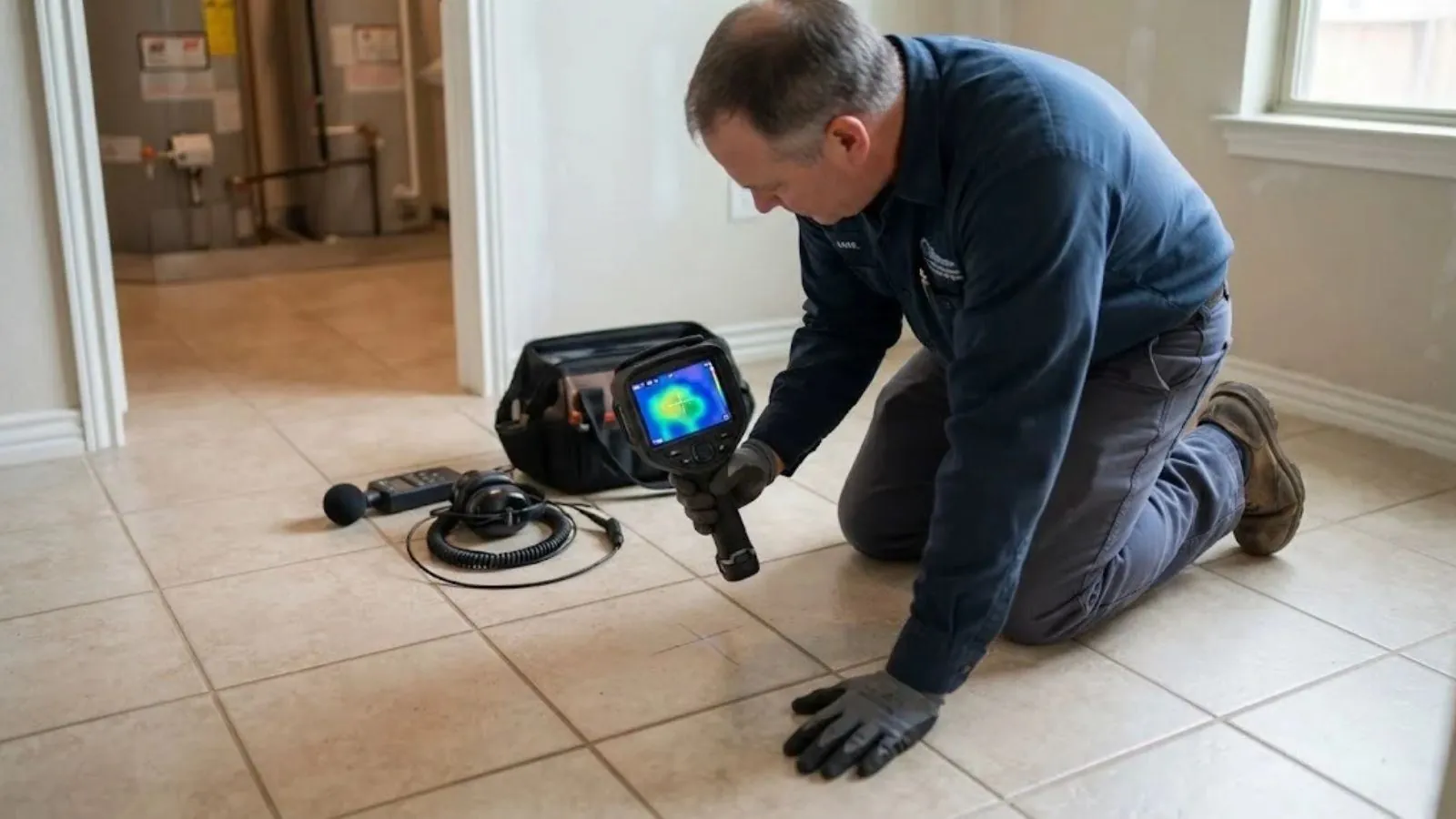
Signs are a warm spot on the floor, a hiss with fixtures off, damp along baseboards, and a meter that moves. Locating the failure uses acoustic listening gear, thermal imaging for hot-water lines, and a pressure test to confirm which line is losing water.
Options include a spot repair through the slab, rerouting the line through walls or the attic, or replacing the run. The pipe material and the number of leaks decide which one makes sense. If the house has a full basement and no slab-level plumbing, the source is probably elsewhere, and it is better to learn that before anyone opens a floor.
Ceiling and wall leaks
A stain on a ceiling shows where water arrived, not always where it started. Water follows joists, pipes, and drywall seams before it shows, so the source can sit a room away. Check what is above first: a bathroom, a laundry room, a roof, or a heating pipe.
Moisture meters and thermal imaging trace the wet area without demolition. A stain that appears after someone showers points to plumbing, while a stain that appears after rain points to the roof or a window. The access hole is usually small and is patched with drywall once the line is fixed.
Act quickly on a wet ceiling. It can sag without warning, and wet insulation hides mold.
Under the house: crawlspaces and basements
Not every home has a crawlspace. Many local homes have a basement instead, and some have both under different wings. Either space helps, because supply and drain lines are often visible from below, which makes leak finding easier than working behind finished walls.
Look for stains on the underside of the subfloor, rusty fittings, wet insulation, a damp floor drain, and chalky white residue on masonry. Pressure testing isolates which line is losing pressure, and moisture readings show whether dampness is a plumbing leak, groundwater through the wall, or condensation on a cold pipe.
That last distinction matters in Park Ridge, where combination sewer flooding is a documented problem. A wet basement floor after a storm is a drainage question, covered on our sump pump repair page. Wet with no rain and no appliance running is more likely a pressurized line.
Underground and buried line leaks
The water service line carries water from the main to the building. The City owns the line up to the buffalo box, the small shutoff valve in a front yard or parkway, and under Municipal Code 11-1-6 the homeowner is responsible from the box to the premises, per the city FAQ. A leak on your side is yours to repair.
Signs include a soft or unusually green strip of lawn, a sinkhole, low pressure, and a meter that runs with the house shut off. Locating starts with acoustic listening at the box and the meter, then a ground microphone to narrow the spot. Tracer gas, a non-toxic blend pushed through the emptied line, escapes at the break and is picked up at the surface by a sensor.
Repair choices, including trenchless methods, are on our water service line repair page. Call 811 before any digging so buried utilities are marked.
Sprinklers, hose bibs, and the area around the buffalo box
Underground sprinklers leak quietly. A cracked head, a stuck valve, or a split lateral shows up as a soggy patch, a zone that never dries, or a meter that runs only when the system does. Park Ridge restricts outdoor watering from May 15 through September 15 on odd and even days by house number (city FAQ), so a system running on the wrong day can also explain a high bill. Check the controller before you chase a leak.
Water pooling around the buffalo box can mean the shutoff is leaking or the line near it has failed. Because that box is where the City's side meets yours, ask Public Works to look before you dig. Pools and spas are different: a falling water level can be plain evaporation, so run a bucket test before suspecting the plumbing.
What you notice, what it usually means, what happens next
| What you notice | Likely source | What happens next |
|---|---|---|
| Meter moves, house main closed | Buried line between the box and the house | Acoustic and ground listening, then spot repair or replacement |
| Meter moves only with main open | Leak inside the house | Fixture checks, pressure test by zone, then wall or floor access |
| Warm patch on a floor | Hot-water line under flooring | Thermal imaging and listening to confirm, then repair or reroute |
| Ceiling stain after showers | Supply or drain line above | Moisture mapping, small access hole, patch |
| Soggy lawn strip, no rain | Service line or sprinkler lateral | Valve isolation and listening, then dig at the confirmed spot |
How leaks get located without tearing things apart
No single tool fits every leak, and a plumber picks based on the symptom. Ask what will be used before work starts.
Acoustic listening
Sensitive microphones hear the hiss of pressurized water through pipe, soil, or concrete.
Thermal imaging
A camera shows temperature differences, which makes hot-water leaks and wet insulation visible.
Moisture meters
Probes read dampness in drywall, wood, and masonry to map how far water has spread.
Pressure testing
A section of line is isolated and watched to see whether it holds pressure.
Tracer gas
A harmless gas blend escapes through the break and is sniffed out at the surface.
Pipe locators
Electronic locators trace the path of buried metal or plastic lines before anyone digs.
Spot repair or replace the line
Spot repair after pinpointing
- Smallest opening, so less damage to finished floors and yard.
- Works when one clean failure sits in otherwise sound pipe.
- Leaves the rest of an aging line in service.
- A second leak on the same line is still possible.
Reroute or replace the run
- Fits lines with repeated pinholes, such as worn galvanized or old copper.
- Larger scope, more disruption, and a permit review through the City.
- Resets the problem for that stretch of pipe.
- Whole-house versions are covered under repiping
What decides the cost of finding and fixing a leak
Locating a leak is a separate step from repairing it, and both vary with access and how much of the line must be traced. For your real number, call our 24/7 line.
Most homeowner policies cover sudden water damage from a burst pipe but not the worn pipe itself, and some limit coverage for slow leaks that went on for weeks. Sewer or sump backup usually needs a separate endorsement, so check your policy and keep photos.
Park Ridge note: meters, bills, and the buffalo box
Park Ridge buys all of its drinking water from Chicago, and the City maintains the water meters. Bills arrive every other month, and the WaterSmart portal offers free leak alerts. Signing up gives you a warning in days instead of weeks, which is useful if you travel or own a second unit.
When water has to be shut off after hours and you cannot reach your own main valve, the City directs residents to the Police Department non-emergency line, and Public Works takes general requests. A street shutoff stops the flow but not the bill, so the repair still matters.
Leak in a shop, office, or restaurant?
Business leaks involve tenants, landlords, and sometimes shared lines, so they are handled on our commercial plumbing page.
Rules for repairs after a leak is found
Finding a leak is diagnosis, but the repair that follows is plumbing work under the Illinois Plumbing Code, 77 Ill. Adm. Code 890. According to the City of Park Ridge resident FAQ, Article 15 of the Municipal Code requires a permit for all plumbing installations or alterations. Ask whether your repair needs a permit before walls or floors are opened.
Frequently asked questions
Yes. Our 24/7 line takes active leaks overnight and on weekends. Tell dispatch whether water is near electrical equipment or the meter is spinning so they can say what to shut off first.
The City owns the line up to the buffalo box and the homeowner owns it from the box to the building, per the city FAQ. Water surfacing in the street or at the box is a call to Public Works. A moving meter with the main closed usually points to your side.
No. The alerts flag unusual use, which tells you to run the meter test. Finding the location still takes listening equipment, pressure testing, or moisture mapping.
Usually the search is narrowed with listening gear, thermal imaging, and moisture readings first. A small access hole may still be needed to confirm the spot and make the repair.
Tell the landlord or property manager in writing first, since they usually authorize repairs. If water is actively entering the unit, close the main valve and report it right away.
The tools are similar, but attic leaks are traced from above and outdoor leaks start at the hose bib, sprinkler, and buffalo box. Tell dispatch where you see water so the right checks come first.