
Water heater leaking right now: what to do first
A leak that is only a slow drip can wait for a morning appointment. A steady stream, a hissing sound or water spreading toward a finished floor is urgent, and the first minutes matter more than the repair itself.
Work from the heater outward. Stop the water feeding it, remove the heat source, then protect the room.
- Smell gas or hear hissing from the burner area? Leave the house and call 911 or your gas utility before anything else.
- Close the cold water shutoff valve on the pipe above the heater by turning the handle clockwise or a quarter turn.
- Electric unit: switch off its breaker. Do not step into standing water to reach the panel.
- Gas unit with no gas smell: turn the gas control knob to Off or Pilot.
- Open a hot tap upstairs so the tank stops pushing water out of the leak.
- Move boxes and stored items out of the puddle and call our 24/7 line.
Where is the water coming from?
The location of the wet spot tells a plumber most of what they need to know before arriving. Look closely, then match what you see to the closest row. If the heater is dry but the floor is still wet, the water may be coming from a supply pipe, and leak detection is the next step.
| What you see | Likely source | What usually happens next |
|---|---|---|
| Water running down the outside of the tank or pooling directly under it | Corroded tank wall or failed tank seam | Repair is not practical. Plan for a replacement. |
| Drips at the pipes on top, at the inlet or outlet connections | Loose or worn fitting, failed union or supply connector | Often a repair: tighten, re-seal or replace the fitting. |
| Water from a pipe that runs down the side of the tank | Relief valve discharging, from pressure, heat or a worn valve | Valve is tested and replaced, and the cause of the pressure is found. |
| Damp or rust at the base of the unit with no steady drip | Drain valve seeping, sweating, or condensation | Valve tightened or replaced. Condensation is confirmed before anything else is touched. |
| Water around a heat pump or high-efficiency gas unit | Condensate line blocked or loose | Drain line cleared and checked. |
Tank leaks, and why they end in replacement
Inside every storage tank is a steel liner that sits in water all day. Over time the protective anode rod is consumed, sediment builds up, and the steel starts to pit. When the wall finally gives way, water seeps from between the tank and its insulation jacket and the leak cannot be patched from outside.
A homeowner often asks if a sealant or epoxy will hold it. Not on a pressurized tank, and not safely. If your heater is old and the base is wet, call us for a leak check and a straight answer on water heater replacement instead of paying to chase a repair that will not last.
Water on the floor or no heat?
Our 24/7 line is staffed for water heater failures at any hour.
The relief valve and what a drip from it means
Every heater has a temperature and pressure relief valve, and Illinois requires one. Section 890.1230 of the Illinois Plumbing Code calls for relief valves on all equipment that heats or stores hot water, with the discharge piped to an indirect connection to waste and made of metal. That pipe is the one you see running down the side of the tank.
If it drips, the valve may be worn, but it may also be reacting to real excess pressure from a closed system or an overheating thermostat. Do not cap or plug it. A plumber tests the valve and checks pressure before swapping any part.
Gas, electric and heat pump units: what changes
The U.S. Department of Energy (energy.gov) describes several water heater types, and repair depends heavily on which you own. The label on the tank names the fuel and model.
Gas storage tank
A burner heats the tank from below and exhaust leaves through a vent. Typical repair parts are the thermocouple, gas control valve, burner assembly and vent connections.
Electric storage tank
Two heating elements and two thermostats do the work. A dead element or tripped high-limit switch explains many cases of lukewarm or no hot water.
Heat pump units
Energy.gov says they can be two to three times more energy efficient than conventional electric resistance heaters, and they need at least 1,000 cubic feet of air around them. Fans, sensors and condensate lines are common repair points.
Hybrid mode
Many heat pump units also carry backup resistance elements. If the heat pump stage stops working, the unit may keep making hot water from the elements, only more slowly and at higher energy use.
Typical age
Energy.gov lists storage and heat pump water heaters at roughly 10 to 15 years. Past that point, a repair bill should be weighed against a new unit.
What we check first
We read the data plate, confirm fuel and age, then test power, gas supply or element continuity before opening anything.
Pilot lights, ignition and venting
A gas heater that will not light, or lights and then goes out, usually has a worn thermocouple, a dirty pilot orifice, a failed igniter or a draft problem in the vent. Newer models have an electronic igniter and an error light that blinks a code. Older ones use a standing pilot you light by hand.
Venting matters as much as the burner. A blocked or backdrafting vent can push combustion gases into the room, which is why the pilot problem should never be solved by repeated relighting. If you smell gas at any point, leave the house and call 911 or your gas utility first, and call us after.
The Consumer Product Safety Commission names water heaters among fuel-burning appliances that can produce carbon monoxide, and recommends carbon monoxide alarms near sleeping areas.
No hot water, lukewarm water and error lights
When the hot water is gone and nothing is leaking, the cause is often small. On electric units, a tripped breaker or failed element is the usual answer. On gas units, the pilot or igniter is the first suspect. Sediment can also insulate the burner or elements from the water and cut output.
Before calling, check that the breaker is on, the gas valve is open, and the thermostat setting has not been bumped. If a code is blinking on the control, write it down. Our plumbers read it against the manufacturer's chart and bring the likely part.
How we find the fault
Identify
We read the data plate for fuel, size and age, and listen to what changed before the problem started.
Test
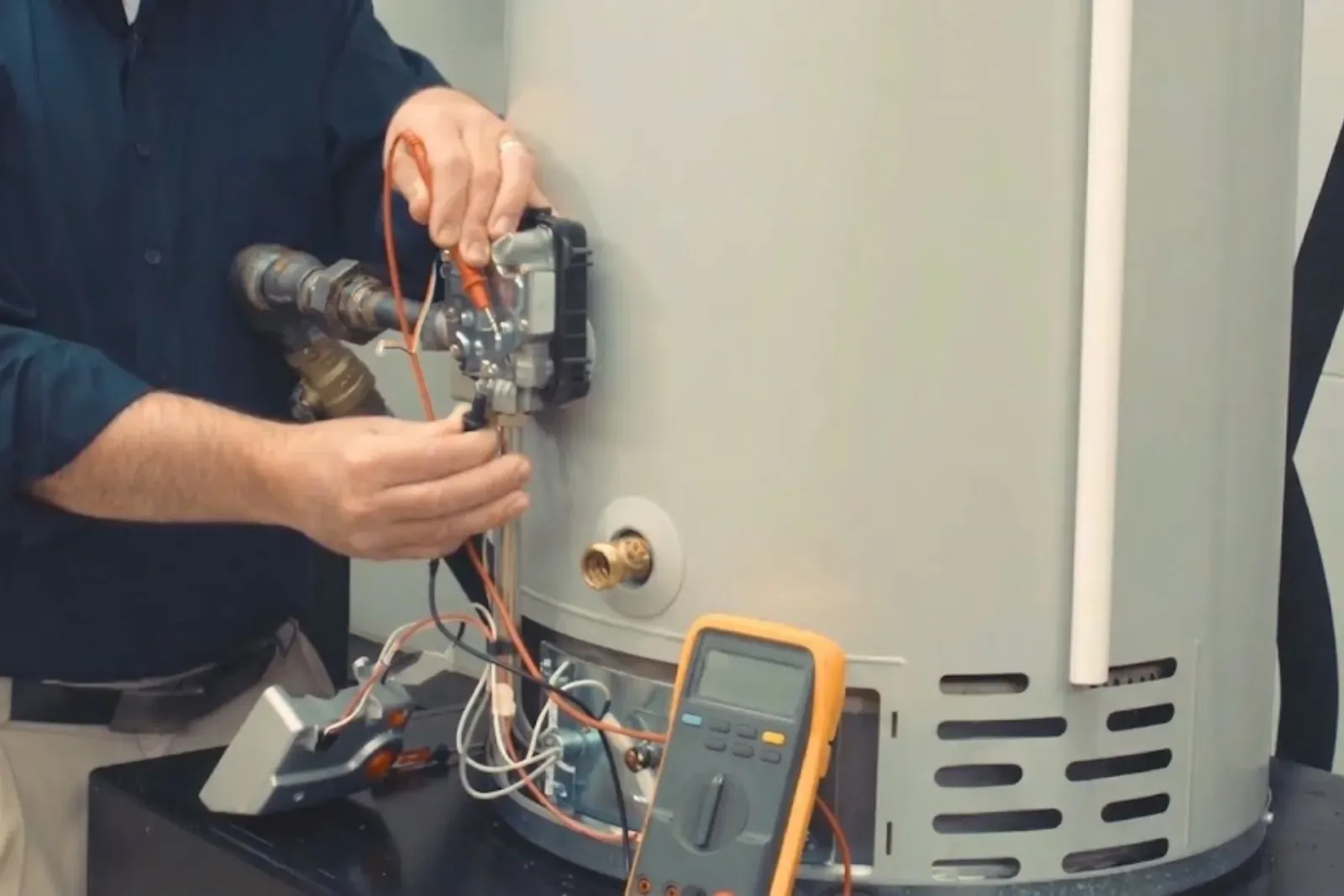
A multimeter checks elements and thermostats, and a pressure gauge on a hose bib tests supply pressure.
Inspect
We examine the vent, the relief valve, the drain valve, the anode rod condition and every fitting.
Quote
You hear the finding and the repair options, with a clear price before work starts.
Repair makes sense, or it does not
Repair is a fair choice when
- The tank body is dry and the leak is at a fitting or valve.
- The unit is well inside its expected 10 to 15 year life.
- The failed part is a thermostat, element, igniter or thermocouple.
- Only one thing is wrong.
Replacement is the better call when
- Water is escaping from the tank wall or seam.
- The heater is near or past the end of its typical life.
- Rust shows at the base and the drain valve.
- Several parts have failed in a short time.
What decides the cost of water heater repair
A thermostat swap and a gas valve replacement are very different jobs, so there is no single number. The plumber reads the problem, then prices the part and the time. For your real number, call our 24/7 line.
Homeowner policies often cover sudden water damage from a failed heater while excluding the heater itself and slow, long-term leaks. Check your policy language and photograph the area before cleanup. A landlord should check the lease for who pays for the heater.
Park Ridge note: shutoffs, permits and your own main valve
The City of Park Ridge FAQ says an after-hours street shutoff goes through the Police Department non-emergency line, and that shutting off water at the street does not stop the bill. For a leaking heater, that is slow. Learn where the shutoff on the heater's cold line is, and where the main valve sits in the basement, so you can stop the water in seconds.
Article 15 of the Park Ridge Municipal Code requires a permit for plumbing installations or alterations. Permit rules vary by job, so we confirm with the Park Ridge Building Department whether a repair needs one. A simple part swap and a full water heater installation are treated differently.
Worth knowing about flushing
Draining a few gallons from the drain valve once a year clears loose sediment and can extend the life of a healthy tank. It does not fix a leaking one. If your tank has not been flushed in years and the drain valve will not open freely, call before forcing it. Tankless units need a different process, covered on our tankless water heater page.
Code and licensing for water heater repair
Repairs to a water heater follow the Illinois Plumbing Code, 77 Ill. Adm. Code 890, and gas or electric connections carry their own safety rules. According to the Illinois Department of Public Health, you can verify a plumber's license on its online lookup before work starts.
Frequently asked questions
Yes. Our dispatch line runs 24/7, including nights and weekends. A leaking tank, a flooded basement corner or a gas-fired heater that will not stay lit all count. Same-day appointments are offered when available, and you hear the price before work starts.
It depends where the water comes from. A leak at a fitting, drain valve or relief valve is often repairable. A leak through the tank wall is not, and replacement is the honest answer.
A slow drip from a fitting can wait for an appointment if you close the supply when not in use. A steady leak, any gas smell or any electrical contact with water is not safe. Shut off the supply and power or gas, then call.
Sediment on the bottom of the tank traps water that boils and bursts through it. A flush may help, but heavy buildup in an old tank can mean the unit is near the end of its life.
Tenants should tell the landlord in writing first. Property managers can call us directly to dispatch a repair, and we explain the findings so the owner can approve work.
The Illinois Department of Public Health licenses plumbers and offers an online lookup. Search the plumber's name before anyone starts work on your gas or water lines.
Lowering the thermostat or switching to a vacation setting saves energy. Closing the cold supply to the heater also limits damage if something fails while you are away.