
Repair or replace: what you notice and what it means
Most disposal calls come down to one question. The table below sorts the common symptoms by the answer.
| What you notice | Repair or replace | Why |
|---|---|---|
| Hums but the blades will not spin | Repair | A jam. Turning the blades by hand with a hex key and pressing reset usually fixes it |
| Silent, no hum at all | Repair first | A tripped reset button, a switch, an outlet or a breaker is more likely than a dead motor |
| Leak at the top where the unit meets the sink | Repair | The mounting ring or seal needs resetting, with new putty or a new gasket |
| Leak at the side hose or pipe | Repair | A loose clamp or a worn gasket on the dishwasher inlet or the drain outlet |
| Leak from the body or the bottom | Replace | The housing seal has failed, and a cracked or rusted shell cannot be patched |
| Repeated jams, rust, grinding and loud noise | Replace | Worn grinding parts and a tired motor are cheaper to retire than to keep fixing |
Disposal leaking or backed up right now: what to do first
A disposal combines a motor, household power and standing water, so safety comes before cleanup. Switch it off at the wall switch, and turn the breaker off too if there is water near the outlet or cord. Our 24/7 line is open at night and on weekends if the leak will not wait.
- Switch the disposal off at the wall and do not run it again
- Turn off the breaker if water is near the outlet, cord or wiring
- Stop using the sink and the dishwasher, since both drain through the disposal
- Set a bucket under the leak and wipe the cabinet floor dry
- Do not pour chemical drain cleaner into a backed-up sink
- Photograph the leak and any damage before you clean up
Jams, humming and the reset button
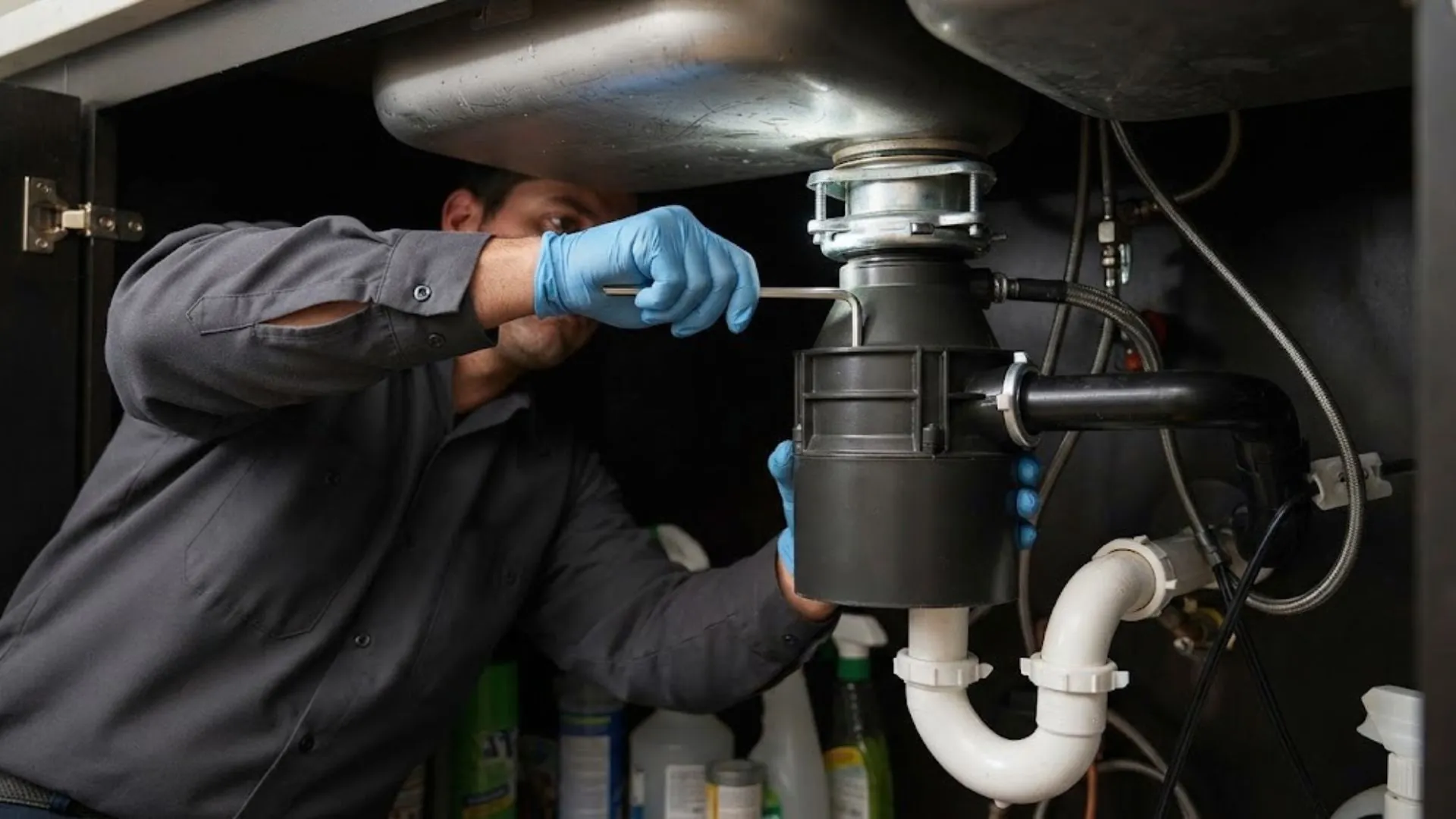
A humming disposal with still blades is jammed. Switch it off at the wall and unplug it or switch off the breaker. Then look at the bottom of the unit for a hex-shaped socket. Work a hex key back and forth in it until the blades turn freely, and pull out whatever caused the jam with tongs, never your fingers.
Wait a few minutes, then press the red reset button on the bottom of the unit. If it clicks and the disposal runs, the overload protector tripped during the jam. If it trips again right away, stop and call, because repeated resets can burn the motor.
If nothing happens at all, check the wall switch, the outlet under the sink if the unit plugs in, and the breaker. Hard-wired units have no outlet to check. Never reach in or poke around while the unit is still connected to power.
Water under the sink?
Switch the disposal off, stop using the sink, and call our 24/7 line.
Where the water is coming from
Where a disposal leaks tells you more than any other clue. Dry everything with a towel, run water for a minute, and watch for the first drop.
Top of the unit
Water where the disposal meets the sink flange means the mounting or the putty seal has failed. It is often a reseal and not a new unit.
Side of the unit
The dishwasher inlet and the drain outlet both attach at the side. A loose clamp or a worn gasket is the usual cause.
Bottom or body
A leak through the housing, or a puddle from the underside, means the inner seal has failed. Replacement is the answer.
The pipe after the unit
The trap and drain arm sit just past the disposal, and a loose slip nut there can look like a disposal leak. Tightening or replacing the trap solves it.
Humming, grinding and kitchen odors
A disposal that grinds slowly or seems weak is often fighting a partial clog downstream, not a failing motor. If the sink also drains slowly with the disposal off, the blockage is in the pipe past the unit, and cabling it is a job for drain cleaning.
Odors usually come from a film of food on the underside of the rubber splash guard, and from scraps clinging to the grinding chamber. Scrub the guard with a brush and dish soap, then run cold water while the disposal runs. If the smell survives a good cleaning, it may be coming from the drain line or trap, not the unit.
Dishwasher drain connection and the air gap
The dishwasher drain hose usually connects to a small inlet on the side of the disposal. A new disposal has a plug inside that inlet called a knockout, and it must be removed when a dishwasher is connected. If the knockout stays in place, dishwasher water has nowhere to go and backs up into the dishwasher.
A dishwasher also needs protection so that dirty sink water cannot flow back into it. That protection is either a high loop in the drain hose or an air gap, a small fitting on the counter or the sink deck. If dishwasher water bubbles up in the sink, the hose, the air gap or the disposal inlet is blocked.
We confirm which arrangement fits your sink and what the Illinois Plumbing Code requires for your setup. We can also reattach a dishwasher line during a disposal visit.
Choosing and installing a replacement disposal
Horsepower is the main spec. Smaller units around one third horsepower suit light use, while half horsepower and above grind more finely and jam less often, which matters for a household that cooks most nights. Higher horsepower also costs more and is usually larger under the sink.
The mount is the next choice. Quick-lock mounts hang the unit on a twist-on ring and install fast, while bolted mounts are sturdier but take more time. Continuous-feed units run while the switch is on, and batch-feed units run only when a stopper is in place, which some households prefer for safety.
Installation covers the sink flange, the drain and dishwasher connections, and the power. A plug-in cord needs a suitable outlet, and a hard-wired unit needs a safe connection to a switch. Park Ridge's code requires a permit for plumbing installations or alterations, so we confirm what your job needs with the Park Ridge Building Department. Larger kitchen changes fall under plumbing installation.
What must never go down a disposal
Most jams and clogs start with something that did not belong in the unit.
- Fats, oils and grease, which cool and coat the pipe.
- Large bones and fruit pits that can jam or dull the blades.
- Fibrous scraps such as celery, corn husks and artichoke leaves.
- Starchy foods like rice, pasta and potato peels in large amounts.
- Glass, metal, plastic, bottle caps and utensils.
- Harsh chemical drain cleaners, which can damage seals and splash on you.
- Paint, solvents and other household chemicals.
Electrical safety before you touch anything
Switch the disposal off at the wall, and turn off its breaker before you reach under the sink, since a wall switch can be flipped by someone else. Never put your hand or any tool other than tongs or a hex key into the grinding chamber. If water has reached the outlet or cord, leave the breaker off and call.
What decides the price of a disposal repair or replacement
Clearing a jam and replacing a unit with new wiring are very different jobs. For your real number, call our 24/7 line.
A sudden leak that soaks the cabinet and flooring may be covered by a homeowner policy, but a worn disposal is usually not. Backup from a clogged line may need a separate endorsement, so check your policy and keep your photos.
Park Ridge note: kitchen grease, your private line and the city sewer
Under Municipal Code 11-1-6, as quoted on the city FAQ, the homeowner repairs the sewer lateral from the house up to and including the connection to the sewer main. Grease from a kitchen sink settles in that private pipe, and any repair there is yours. Keeping fat out of the disposal protects a pipe you own. If the pipe itself has failed, sewer line repair is the next step.
The city FAQ also recommends a sewer cleanout for inspection access. If your kitchen sink backs up with the disposal off and the trap clear, the blockage is past the disposal, and a cleanout lets a plumber cable the line. When a clog keeps returning, sewer line cleaning clears the main run.
Code notes for disposal work
A disposal ties into the sink drain and the home's electrical supply, so each half has its own rules, according to the Illinois Plumbing Code and the electrical code that applies to your home. The plumbing half follows the Illinois Plumbing Code, 77 Ill. Adm. Code 890, and the wiring half should be handled by someone qualified for electrical work.
Frequently asked questions
Yes. Our dispatch line is open 24/7 for leaking, jammed or backed-up disposals. Same-day appointments are available when the schedule allows for problems that can wait.
Yes, once the unit is switched off and has cooled for a few minutes. If it trips again right away, stop and call. Repeated resets can burn the motor.
The drain past the disposal is partly blocked, or the dishwasher knockout is still in place. Switch the unit off, and call if the water does not clear on its own.
Usually, yes, if the sink drain fits and there is a safe way to power it. A plumber confirms the drain setup, and we check permit needs with the Park Ridge Building Department.
Switch the unit off, stop using the sink and tell your landlord or property manager right away. Your lease decides who pays, and we can work with either of you.
No. Most odors come from food film on the splash guard. Scrub it, run cold water, and call if the smell stays after a good cleaning.
It depends on how your dishwasher drain is arranged. We confirm what the Illinois Plumbing Code requires for your setup and install the right protection.