
Connect to what you have, or run something new?
Every installation begins with the same decision. If the new fixture sits near an existing supply and drain, the job is mostly connections. If it sits across the house, or below the level of the sewer line, new piping has to be planned.
That choice drives permits, wall access, and how long the water is off. Walk the plumber through the room and point out the nearest sink, toilet, or laundry stack. A short conversation in the space usually answers more than a phone description.
Which project are you planning?
| Project | What it usually involves | Planning notes |
|---|---|---|
| Swap a fixture in the same spot | Shutoff, disconnect, reconnect, test | Often no new piping, ask about permit rules |
| Move a sink or toilet | New supply and drain routing, wall or floor access | Vent and slope matter, plan the route first |
| Add a bathroom | Supply, drain, vent, and sometimes a pump | Permit and inspection, see the pump comparison below |
| Hook up an appliance | Supply stop, drain or standpipe, sometimes a pan | Match the connection type to the appliance |
| Remodel rough-in | Pipes placed in open walls before drywall | Inspection comes before the walls close |
Basement bathroom: ejector pump or gravity drain
Gravity drain
- Works when the fixture sits above the sewer lateral.
- No motor to fail, no power needed.
- May require breaking the slab to set the drain at the right slope.
- Best when the basement has a floor drain or stack low enough.
Ejector pump
- Lifts waste up to the drain when the fixture sits below it.
- Lets you add a bathroom without lowering the line.
- Needs power, a sealed basin, and a vent, and it can fail like any pump.
- Needs periodic checking, and an alarm is wise.
Not sure what the project needs?
Describe the fixtures and the room, and we will explain what is involved before anything is scheduled.
Fixtures and appliance hookups
Sinks and faucets
New supply stops, a trap, and a drain that slopes correctly. Pairs with faucet repair when an old unit is the real problem.
Toilets
A secure flange, a new wax ring or equivalent, and a supply stop. See toilet repair for failing existing units.
Showers and tubs
Valve body, drain, and trap, with a pan or liner checked before tile.
Washer and dishwasher
Supply stops, a standpipe or air gap, and a hose set suited to the appliance.
Outdoor taps
A hose bib with a shutoff that can be drained for winter and a backflow device.
Water heater tie-in
Handled as its own project, see water heater installation.
Remodels: rough-in, relocation, and new water lines
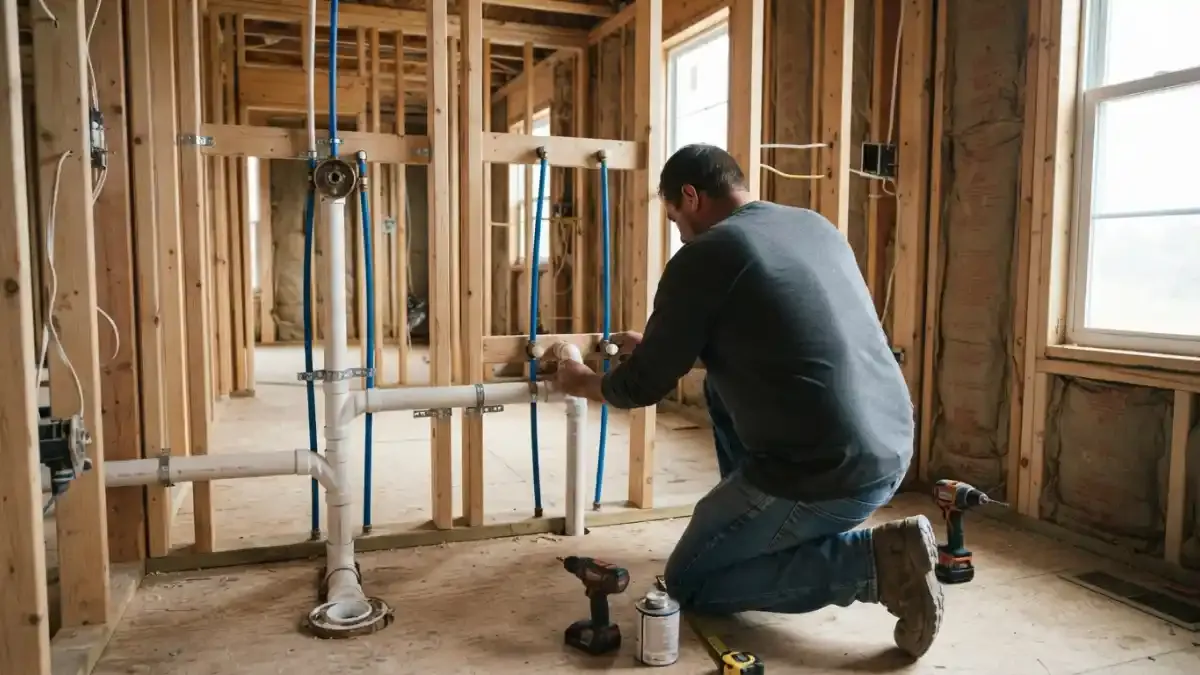
A remodel is the easiest moment to fix plumbing because the walls are open. Rough-in is the stage where supply, drain, and vent pipes are placed and pressure tested before drywall. Inspectors usually see it at this stage, so the plumbing must be right before anyone hangs a board.
New water lines branch from the existing supply, and a larger addition may expose that the main line is undersized or the service entry is old. If the whole house is being gutted, ask whether now is the moment to replace worn pipe, which is the subject of repiping. If the incoming line is the weak link, the underground side is covered under water service line repair.
New construction plumbing
On new builds and additions, plumbing happens in phases: underground drains before the slab or foundation backfill, rough-in inside the frame, and fixture set at the end. Each phase has an inspection. We coordinate with the builder so pipes are in the right place before concrete or framing closes them in.
Permits and inspections: Article 15
The Park Ridge city FAQ says Article 15 of the Municipal Code requires a permit for all plumbing installations or alterations. It also calls for written permission from the Building Department before any material change, and a certificate of inspection and approval before a new plumbing system is used. A building permit is also required for work on water supply, plumbing, and sewer piping.
Permit rules vary by job, so we confirm with the Park Ridge Building Department. The Illinois Plumbing Code is 77 Ill. Adm. Code 890, and plumbers are licensed by IDPH, which has an online lookup you can use to verify any plumber.
Planning checklist before the first pipe is cut
- Sketch the room and mark where each fixture goes.
- Find the nearest existing supply, drain, and vent, and the main shutoff.
- Decide on fixtures and appliances before rough-in, since rough-in dimensions depend on them.
- Ask whether the work is above or below the sewer line height in the basement.
- Confirm permit and inspection timing so walls are not closed early.
- Plan where water will be off and for how long.
- Keep spec sheets for fixtures and appliances so the connections match.
What changes the price of an installation
Installation pricing follows scope, access, and fixtures, not just the number of fixtures. For your real number, call our 24/7 line.
Homeowner insurance usually does not pay for planned improvements, and a leak from poor installation may be treated differently from a sudden pipe burst. Keep permit paperwork and photos of the open walls with your records.
Park Ridge note: planning below the sewer line
The county hazard plan says nearly 500 Park Ridge basements flooded on July 23, 2011, and it attributes much urban flooding to the city's combination sewer system. A basement bathroom sits where sewer water backs up first, so ask about backflow protection and where the discharge goes.
Pumps in a basement also depend on power during storms. Our sump pump repair page covers battery backups, and the Park Ridge Building Department can say what the code requires for your project.
What to do before the installer arrives
New plumbing follows the Illinois Plumbing Code, 77 Ill. Adm. Code 890. According to the City of Park Ridge resident FAQ, Article 15 of the Municipal Code requires a permit for all plumbing installations or alterations. Before the visit, clear the work area, know where your main shutoff is, and photograph existing pipes so the plumber can see what is already in the wall.
Frequently asked questions
Yes. Our dispatch line is open 24/7, and installation visits can be scheduled for evenings or weekends when the schedule allows. If water is actively leaking, tell us so that gets handled first.
The city FAQ says Article 15 requires a permit for plumbing installations or alterations. Rules vary by job, so we confirm with the Park Ridge Building Department before starting.
If the fixture sits below the sewer lateral, a pump is usually how waste reaches the drain. If it sits above, gravity may work. A site visit and a look at the lateral depth answer this.
Yes. Those are common jobs. Tell us the fixture type and whether it replaces an existing one so we can plan the supply and drain.
Yes, with the owner's authorization and notice to the tenant for water shutoffs. Mention access times and shared lines so work can be sequenced around the unit.
A water heater is its own project with its own page and permit steps. We can coordinate it with other plumbing so the water is off once.