
A snake went in and the clog came back
This is the story we hear most. Someone ran a cable, the water drained, and a month or two later the same drain was slow again. Sometimes the cable stopped short and the plumber could not get past a point in the line.
A cable opens a channel through a blockage. It does not remove the grease, scale or sludge that lines the rest of the pipe, so the channel narrows again as new material sticks to what is left. If that sounds like your house, a camera look and a jetting pass are the usual next step. For a one-off clog, ordinary drain cleaning with a cable is often enough.
Emergency hydro jetting: when a backed-up line cannot wait
Call at once if sewage or gray water is rising in a floor drain, tub or shower, or if every fixture on the lowest floor is slow together. A line that is fully blocked needs clearing before another load of laundry or another flush.
We handle these after hours and on weekends. If the line holds up better with a short cable pass first, the plumber may open it that way and schedule the jetting for a same-day or next-day visit once the water is down.
Line backing up now: what to do before the jetter arrives
Jetting adds water to the line, so the house should be as quiet as possible before work begins. A calm start also helps the plumber find the cleanout.
- Stop all water use: showers, laundry, dishwasher and toilet flushes.
- Find your cleanout if you know where it is, and clear space around it.
- Move stored items off the basement floor and away from the floor drain.
- Keep children and pets out of any area with wastewater and wash hands after contact.
- Do not pour drain cleaner into the standing water.
- Tell the dispatcher when the line was last cleared and by what method.
Cable did not hold?
Tell the dispatcher how long ago the line was cleared and how fast it backed up again.
Snake or jet: which one should you pick
Match the tool to what the line is doing, not to what the last visit used.
| Situation | Better first choice | Why |
|---|---|---|
| One sink or tub clogs once, no history | Snake or hand tool | A single soft clog does not need a high-pressure pass. |
| Same drain clogs every few months | Camera, then jetting | The pipe wall likely holds grease or scale that a cable leaves behind. |
| Cable stopped short in the line | Camera first | Something solid, a break or roots may be stopping the cable. |
| Slow flow in a large kitchen or laundry line | Jetting | Water scours the inside wall and flushes the loosened debris out. |
| Roots show on a past camera video | Root-cutting jet nozzle, then repair plan | Roots return unless the opening they use is sealed. |
| Pipe is cracked, sagging or collapsed | Repair first, not jetting | High pressure can make weak pipe worse. The fix is repair. |
Inside the jetting equipment
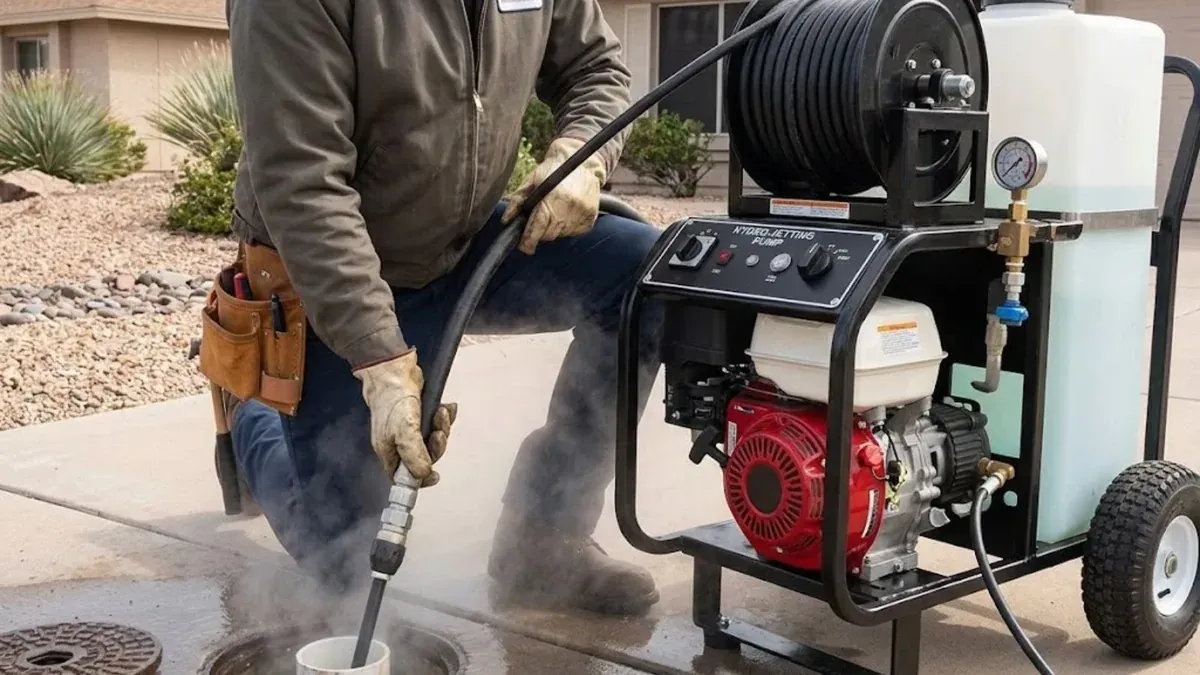
A jetter is a pump, a spool of high-pressure hose and a set of nozzles. The plumber picks the nozzle for the job and feeds the hose in through a cleanout or an opened drain.
Penetrating nozzle
A forward-facing jet that drills through a dense plug so water can reach the rest of the line.
Rear-facing spinner
Jets point backward, which pulls the hose along and scours the wall as the nozzle is drawn back.
Root-cutting nozzle
A rotating head with a cutting edge or a ring of jets that trims roots at a joint or crack.
Camera partner
A push camera before and after shows the plumber what is in the pipe and whether it worked.
What jetting can and cannot do
What it does well
- Removes grease, soap scale and sludge from the pipe wall.
- Clears blockages that a cable pushes through but cannot remove.
- Trims roots that have grown into joints and clears the pieces.
- Leaves a cleaner line that gets a clear camera view.
What it cannot do
- Fix a cracked, offset or collapsed pipe. Jetting clears the line but does not repair it.
- Stop roots from returning. They grow back through the same opening.
- Run safely through very fragile pipe. One municipal lateral lining program notes that older fiber pipe can be damaged by jetting.
- Replace a camera inspection. It cleans the pipe but cannot tell you the pipe is sound.
Roots in the line: what jetting does about them
Roots seek water and enter a pipe at any gap, then spread into a mat that catches paper and grease. A root-cutting nozzle clears the mat and lets the line flow again, often for months or longer.
The Park Ridge city FAQ says roots do not invade structurally sound sewer pipes. So a root problem usually means a joint has opened or the pipe has cracked. Clearing the roots buys time, but a sewer line repair is the lasting fix, and a camera shows where the gap is.
How a jetting visit goes
Look
A camera or a quick cable test shows where the line is blocked and what shape the pipe is in.
Access
The hose goes in through a cleanout, a pulled toilet or an opened drain.
Jet
Water pressure drives the nozzle forward and scours the wall as it is pulled back.
Recheck
A second camera pass confirms the line is open and shows any damage the grease was hiding.
Park Ridge note: why a clean main line matters here
Park Ridge's hazard mitigation plan, a Cook County document, describes an antiquated combination sewer system and records nearly 500 flooded basements on July 23, 2011. That tells you the public sewer can be overloaded in a storm, and a clear private line cannot stop that, but a partially blocked one makes a bad day worse.
The city FAQ places the sewer lateral, up to the main, in the homeowner's hands under Municipal Code 11-1-6. That is the pipe jetting cleans. For access, the city recommends a cleanout, and our sewer line cleaning page covers the main and the lateral in more detail.
What decides the cost of hydro jetting
Jetting is a larger job than a cable, with heavier equipment and usually a camera. Price depends on the line, not a flat menu. For your real number, call our 24/7 line.
Homeowner insurance generally treats jetting as maintenance and does not pay for it. A backup that ruins finished flooring is a separate question, and it may be covered only with a water backup endorsement, so check your policy.
Standards and safe jetting practice
Jetting is done through an access point such as a cleanout, and any change to that access has to meet the Illinois Plumbing Code, 77 Ill. Adm. Code 890. According to the city FAQ, tree roots do not invade structurally sound sewer pipes, which is why a camera check follows a jet.
Frequently asked questions
Yes. Our emergency line is open 24/7. If a line is backing up after hours, a plumber can open it with a cable or jetter, and a planned jetting visit can be booked same-day when the schedule allows.
Not always. Fragile or cracked pipe can be damaged by high pressure, which is why a camera check comes first. If the pipe is weak, repair is the safer plan.
There is no set schedule. Some kitchen and laundry lines fill with grease every few years, and a camera after cleaning shows how quickly buildup is returning.
No. It clears debris. A collapsed or badly cracked section needs repair or replacement, and the camera is how we find out.
No. It cuts and flushes them, but roots return through any open joint. A repair that seals the gap is what keeps them out.
Get a camera pass and a cleaning together, and keep the video. If tenants in several units report slow drains, the shared line is the likely cause.