
Repair it, line it or leave it alone: the question a camera answers
Every sewer decision starts with the same unknown: what is inside the pipe. Without a look, a plumber can only guess whether a repeat clog is hair and grease, a root, or a crushed section. A camera replaces guessing with a picture.
That picture decides how much money you spend. It can show a clean, sound line that needs nothing, a single defect that needs a spot repair, or damage long enough to justify lining or replacing. See sewer line repair once the video points that way.
Pre-purchase: is a sewer scope worth it before you close
A general home inspection may not include a sewer camera, so ask what yours covers. Use this as a guide.
| Situation | Scope the sewer line? | Why it matters |
|---|---|---|
| Single-family home with a private lateral | Yes, usually | In Park Ridge the homeowner repairs the lateral up to the main, so the buyer inherits any defect. |
| House with a large tree near the front yard or street | Yes | Roots are a common reason a line needs repair, and the camera shows if they are in the pipe. |
| Seller says the line was cleaned recently | Yes, and ask for the recording | A cleaning and a camera pass show whether it was a one-time clog or a damaged pipe. |
| Basement shows water marks or a damp floor drain | Yes, before you close | It may be a storm backup or a pipe defect, and the video helps tell which. |
| Condo or unit with a shared main | Ask the association first | The shared pipe may belong to the association, not to you. |
What the camera shows and what it cannot
What you see on screen
- Cracks, broken sections and offset joints.
- Roots entering at a joint or crack.
- Sags or bellies where water sits.
- Scale, grease and debris that narrow the pipe.
- Where the pipe turns, joins another line or meets the street.
What it cannot tell you
- Whether the city main in the street is sound.
- Why a defect formed. The video shows condition, not cause.
- Hidden leaks at fittings if the camera cannot pass them.
- Anything past a blockage until the line is cleared.
- Your insurance coverage. That is a policy question.
Buying a home?
Tell us your closing window and where the cleanout is, if you know.
How an inspection goes
Access
The plumber opens the cleanout, or pulls a toilet if there is none.
Clean
A blocked or heavily coated line is cleared first so the lens can see.
Record
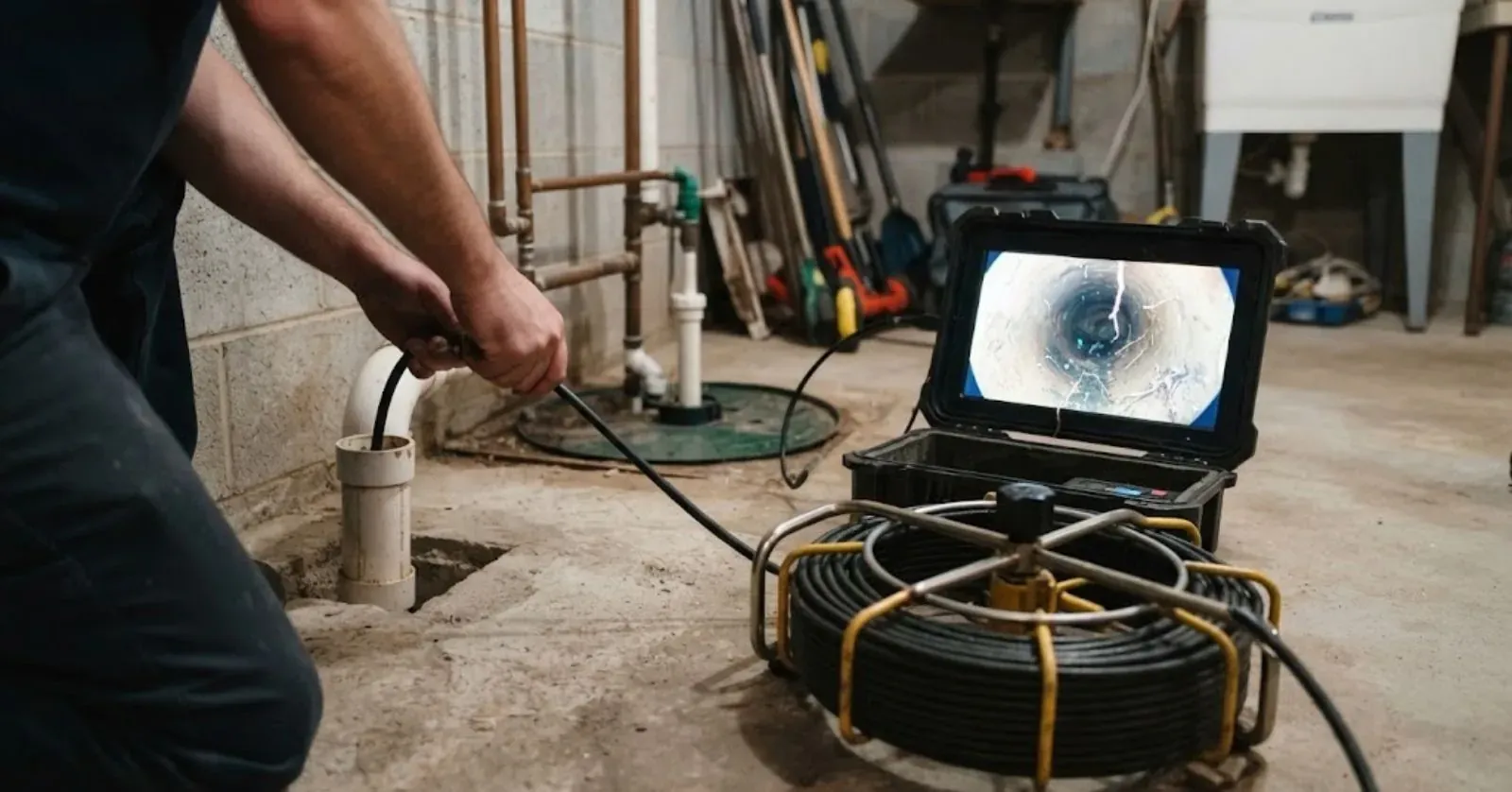
The camera runs from the house toward the street while a screen and recorder capture the view.
Review
You see the video, and we mark the defects and explain what each one means.
Locating the line and the problem spot
The camera head carries a small transmitter. A hand receiver at the surface picks up its signal and shows the depth and position of the pipe, so we can mark a crack on your lawn or driveway.
That mark matters if a dig is needed. It tells you how far the defect is from the house, whether it falls under a tree or slab, and whether it sits on your lateral or out in the public street. We note it on the recording.
Getting a recording you can keep
Ask for the video file, not just a verbal report. A recording lets a second contractor give a bid, lets a buyer negotiate with the seller, and lets you compare the line after a repair.
Ask that the recording show the full run, with a footage counter or a note of distance. A video that stops at the first bend answers less than one that reaches the street. If the pipe needs cleaning first, ask us about hydro jetting as a separate step.
How to read the findings
You do not need to be a plumber. These are the shots that matter and what each usually means.
Clear and smooth
The pipe is intact, so a past clog was likely a plain blockage.
Roots in a joint
A root mat means the joint is open. Cutting roots helps for a while, but sealing the gap lasts longer.
Standing water in a dip
A belly. Waste settles there and the line may clog again.
Cracks or missing pipe
A broken section may need spot repair, lining or replacement.
Rough, flaking walls
Corrosion or scale. If the pipe is cast iron, it is a sign the interior is wearing.
Offset ledge
A step between pipe ends. It catches paper and can get worse over time.
Before lining: why the camera comes first
Lining puts a new resin pipe inside the old one. A municipal lateral lining program says its liner cannot be used on collapsed or back-pitched pipe and requires a recorded camera pass to confirm the pipe qualifies.
So the inspection is the gate. If it shows a clean, straight, intact pipe, lining can be an option. If it shows a collapse, a repair has to come first. Read the trade-offs on the sewer line repair page before you decide.
Park Ridge note: a cleanout makes every inspection easier
The Park Ridge city FAQ recommends a sewer cleanout for inspection access and, quoting Municipal Code 11-1-6, makes the homeowner responsible for the lateral up to and including the connection to the main. A cleanout is a capped pipe that gives direct entry to the line.
One county public works page describes a cleanout as often sitting a few feet from the house or near the front property line, and suggests a camera check every three to five years. That is that county's advice, not a Park Ridge rule.
If you cannot find a cleanout, a plumber can scope from a pulled toilet, but it takes longer. Adding a cleanout may need a permit, since Article 15 of the Municipal Code covers plumbing alterations. Permit rules vary by job, so we confirm with the Park Ridge Building Department. After a backup, sewer line cleaning and a scope together give the clearest picture.
What decides the cost of a sewer camera inspection
An inspection is a short visit for some houses and a long one for others. For your real number, call our 24/7 line.
Homeowner insurance usually does not pay for an inspection, since it is maintenance. If it finds a sudden covered loss, the recording supports your claim. Check whether your policy has a water backup endorsement before you buy or after you move in.
Standards for camera inspection
A camera inspection is observation, and what it finds feeds into repairs governed by the Illinois Plumbing Code, 77 Ill. Adm. Code 890. According to the city FAQ, the homeowner repairs the sewer lateral up to and including the connection to the sewer main, so the footage tells you which side owns the fix.
Frequently asked questions
Yes. Our line is open 24/7, and same-day appointments are available when the schedule allows. If a sewer is backing up right now, tell the dispatcher so it is handled as an emergency.
It depends on access and the line's length and condition. A clear line with a cleanout goes faster than one that must be cleaned first, and we explain that before we start.
Not directly. It shows the condition and often the material, but not an age, so we do not state one.
No. It diagnoses. If the video shows damage, we explain repair options and prices before any work starts.
Yes. We give the owner a recording and a short written summary so the repair decision does not rest on a verbal report.
That is between the two sides and their agents. Either can order one, and a recording works for both.