
The shower goes cold, a code appears, or the unit sounds wrong
Tankless trouble tends to show up as a pattern. Hot water starts fine, then fades when a second tap opens. A display shows a numbered code. The flame cycles on and off, or the unit clicks and goes quiet. Each pattern points at a different part of the system.
A fading shower can mean the unit is being asked for more flow than it can heat. A code and no ignition may point to gas supply, venting or a sensor. Reduced flow and a rumbling sound often point to scale inside the heat exchanger, which is why the flush section below matters. Write down the code and when the problem started before you call.
Tank versus tankless: the honest comparison
Tankless is not better for every house. This table shows where each type usually wins.
| Question | Storage tank | Tankless |
|---|---|---|
| How long does it last? | Energy.gov lists about 10 to 15 years | Energy.gov lists about 20 years |
| How much hot water at once? | A set amount, then it recovers | Limited by flow rate, about 2 to 5 gallons per minute per energy.gov |
| Space | Needs a floor footprint for the tank | Wall mounted and small |
| Install demands | Often a straight swap | May need a larger gas line, a new vent or a heavy electric circuit |
| Maintenance | Flush sediment, check the anode rod | Descale the heat exchanger and clean the inlet filter |
| Upfront work | Lower in most homes | Higher in most homes, depending on the changes needed |
Tankless flush and descaling
Minerals dissolved in water leave a hard deposit, called scale, when the water is heated. In a tankless unit that deposit forms on the narrow passages of the heat exchanger, where it restricts flow and traps heat. The result is lower output, noise, error codes and eventually damage.
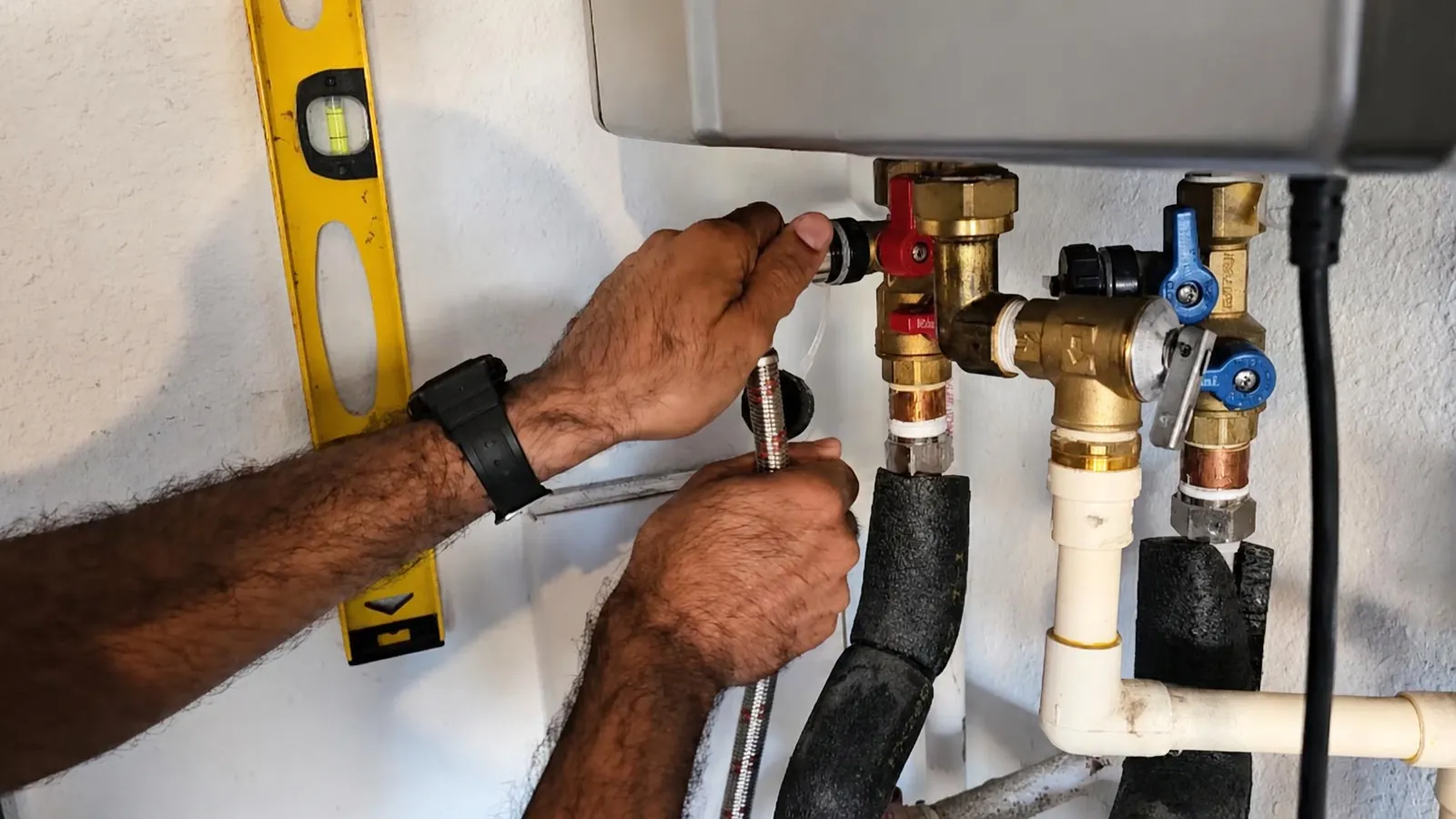
A flush uses a pump, two hoses and a descaling solution circulated through isolation valves on the unit, then rinsed clean. The manufacturer's manual sets the solution and the interval. Without isolation valves, we can add them during the visit, which makes every later flush easier.
How fast scale builds depends on your water. We do not guess at a hardness number for Park Ridge. Test your tap with a home kit or lab, and ask the Park Ridge Public Works department for the annual water quality report. Park Ridge buys its water from the City of Chicago, which draws from Lake Michigan, but that source does not tell you what your own plumbing and fixtures add.
Tankless acting up?
Describe the error code and when the hot water drops.
Tankless water heater installation
Installing a tankless unit is less about the box and more about what feeds it. A gas model draws more gas at once than a tank heater does, so the gas line size and the meter capacity matter. An electric model can pull a very large load, so the panel has to have room for it.
Venting changes too. Many gas tankless models use sealed plastic venting that can run through a wall instead of a chimney. Your plumber measures the run before ordering. If you are converting from a tank, our water heater installation page explains permits and prep. Under Article 15 of the Park Ridge Municipal Code, plumbing installations need a permit, and we confirm the details with the Building Department.
Gas or electric tankless: where each one pinches
Gas tankless
- Higher flow capacity, so it is better for larger homes.
- Needs a correctly sized gas line and a vent.
- More parts to service: burner, igniter, flame sensor, fan.
- Needs a condensate drain on high-efficiency models.
Electric tankless
- No vent and no combustion.
- Needs a large dedicated circuit, often more than a panel has spare.
- Flow may be limited in cold months when incoming water is colder.
- Fewer wear parts, but the elements still scale.
Flow rate limits: why a second shower can ruin the first
Energy.gov says tankless output is limited to about 2 to 5 gallons per minute and that multiple heaters may be needed if hot water demand is high. A single shower, a dishwasher and a running washer can add up to more than one unit can heat to the set temperature.
Count what runs at the same time in your house on a busy morning. If the answer is more than one unit can handle, the choices are a larger model, a second unit or staggering use. We tell you this before you buy, not after the first cold shower.
Tankless water heater repair
Common repair items include a clogged inlet filter, scaled heat exchanger, failed flame sensor, igniter, flow sensor or fan, a cracked condensate trap, and vent blockage. Leaks from a tankless unit usually come from a union, a valve or the heat exchanger itself.
If the unit is under its manufacturer's coverage, we explain how to proceed so you do not lose it by hiring the wrong repair. If the cost of a repair approaches the cost of a replacement on a unit near the energy.gov figure of 20 years, we say so. For tank-style units, see water heater repair.
Before you buy tankless
Count simultaneous taps
How many showers, sinks and appliances run at once in the morning?
Check the gas line
Pipe size, run length and meter capacity decide gas models.
Check the panel
Electric models need a lot of breaker space that many panels lack.
Plan the vent
The wall route, termination and clearances all need to work.
Know your water
Test it. Hard water means a flush schedule, and possibly a softener. If you are replacing a tank, our water heater replacement page covers the other options.
Plan for service
A yearly flush is part of owning one.
Park Ridge note: your water source and what to do about scale
The City of Park Ridge buys all of its drinking water from Chicago, which draws from Lake Michigan, according to the city's 2020 water quality report. That report does not publish a hardness figure, so do not assume scale will or will not be a problem for your unit.
Test your tap, ask the city for the current annual report, and check the unit's manual for flush timing. If testing shows a scale problem, water softener and filtration options are worth a look.
What drives the cost of a tankless job
A tankless project can be a modest swap or a multi-trade upgrade, depending on the house. For your real number, call our 24/7 line.
A planned upgrade is generally not an insurance matter. Sudden water damage from a failed connection might be, but check your policy. Landlords should keep the unit's manual and flush records for the next tenant.
Frequently asked questions
Follow the manufacturer's manual, since schedules differ by model. How quickly scale builds depends on your water, so test your tap and ask Park Ridge Public Works for the annual water quality report.
Codes usually point at ignition, venting, flow, temperature or a sensor. Write down the number and call, and we read it against the manufacturer's list.
Yes, our dispatch line is open 24/7, and same-day appointments are offered when available.
Sometimes. Energy.gov says output is limited to about 2 to 5 gallons per minute, so a large household may need a bigger unit or two.
Not always. Gas tankless units draw more gas at once, so the pipe and meter are checked before an order.
In a closed water system, thermal expansion can still raise pressure. We confirm on site against the pressure reading and code.
It depends on the number of units, the gas and panel capacity and your tenants' use. We evaluate one building at a time.