
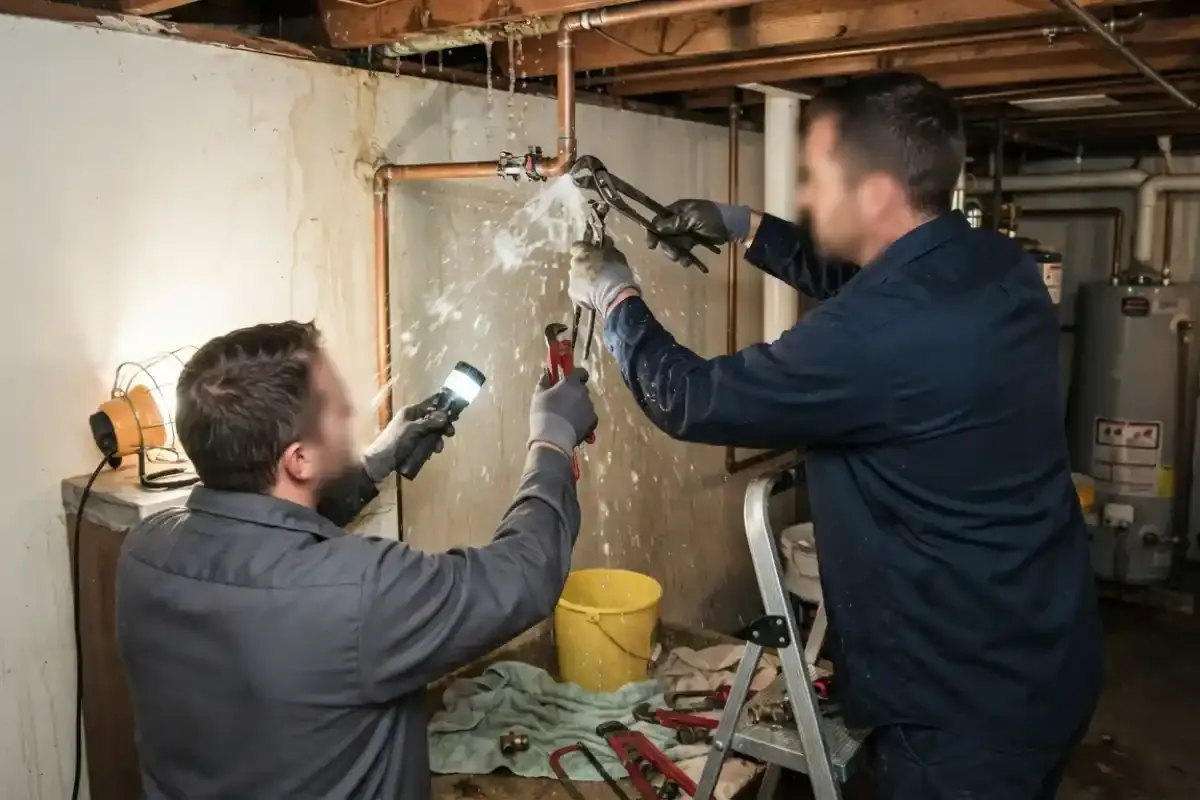
When pipes burst: cold snaps, thaws and worn-out joints
Pipes usually fail in one of two ways. A hard freeze puts ice inside a pipe and the pressure splits the wall, often at a spot you cannot see. The split may stay quiet until the ice melts and water starts to flow.
The other way is age and wear: a pinhole in a corroded line, a joint that lets go, or a fitting that has leaked slowly for years. That kind can happen on a warm day, and the signs are a wet ceiling, a stain on a wall, or a sudden drop in pressure.
Burst pipe: shut it off and limit the water
Water gets worse every minute it runs. The first job is to stop it at the source, and the second is to keep it from reaching electrical parts.
- Close the main shutoff valve, usually near the water meter or where the line enters the house.
- Open the lowest cold tap and flush upstairs toilets once to drain the pipes.
- If water is near outlets, appliances or the panel, stay out of that room and do not touch anything electrical.
- Move furniture and valuables out of the wet area, and put out towels and buckets.
- Take photos of the damage before cleanup for your insurance claim.
- Call our 24/7 line and tell us what is wet and where the water started.
Find your shutoff valves before you need them
In an emergency, the person who knows where the valve is saves the floor. Check now.
- The main shutoff is where the water line enters the house, often in a basement near the meter.
- A ball valve has a lever that turns a quarter turn. A gate valve has a round handle that turns several times.
- Turn each valve once a year so it does not seize.
- Look for fixture shutoffs under sinks and behind toilets too. They isolate a small leak without losing water to the whole house.
- If the main valve will not close, tell the dispatcher. Park Ridge's city FAQ says after hours, residents can reach the city for a street shutoff through the Police Department non-emergency line.
- Remember that a street shutoff stops the water but does not stop the bill, per the city FAQ.
Water still flowing?
Tell the dispatcher where it is coming from and whether you shut off the main.
Frozen pipe repair: thawing without making it worse
Shut off
Close the main valve first, in case the pipe has already split.
Open a tap
Open the nearest faucet so water and steam can leave as the ice melts.
Warm slowly
Use a hair dryer, a space heater kept away from anything flammable, a heat lamp or towels soaked in hot water.
Watch
Work from the faucet end toward the frozen part, and look for leaks as flow returns.
Never thaw a pipe with an open flame
An Iowa State University Extension guide says plainly never to use an open flame to thaw a water line. A torch can ignite framing or insulation, scorch a soldered joint and scald you with steam. If you cannot reach the frozen section, or it is behind a finished wall, call us.
Copper, PEX and galvanized: how each one fails and gets fixed
The material decides the repair. If you do not know which you have, a plumber can tell by looking.
| Pipe type | How it usually fails | Typical repair |
|---|---|---|
| Copper | Splits from freezing, or pinholes from corrosion | Cut out the damaged length and join new copper or a compatible fitting. |
| PEX | Fittings and crimp rings fail more often than the tubing, which tolerates freezing better than rigid pipe but is not freeze-proof | Replace the failed fitting or the damaged length of tubing. |
| Galvanized steel | Rust narrows the bore and weakens walls, so one leak often means more are coming | Replace a section, or consider replacing the line if the pipe is worn throughout. |
| Mixed or unknown | Failures at the joint where two metals meet | Identify the materials first, then choose fittings that suit both. |
Cracked or broken pipe: finding where it failed
Not every broken pipe shows itself. A split can sit inside a wall, under a slab or above a ceiling, and the first sign may be a stain, a sound of running water, or a water meter that moves with every tap closed. We trace the water back along its path to the real break.
A visible crack at a fitting is a quick fix. A hidden split takes tracing, and sometimes an opened wall. If we cannot see the failure, we use leak detection tools such as acoustic listening and thermal imaging to narrow the search before cutting.
Pipe leak repair when it is not a full burst
A small leak is cheaper than a burst, but it does not stay small. A dripping joint rots the wood around it and breeds mold. If water is visible and you can shut off a fixture valve, do that, then book the repair the same day when possible.
Copper pipe repair
Copper pipe is cut back to sound metal, cleaned, and joined with a new piece by soldering or a push-fit coupling. The joint should be tested under pressure before the wall is closed. Some copper that has pitted in several places is better replaced by the run than patched one pinhole at a time.
Drain pipe repair
A burst is a supply-side problem, but drain pipes crack too. A cracked drain leaks only when water runs through it, so the leak may seem to come and go. For clogs, see drain cleaning. A cracked underground drain may need the sewer line repair process described on our sewer line repair page.
Patch a section or replace the run
Repair the damaged section
- Fastest way to restore water.
- Cheaper when the rest of the pipe is sound.
- Leaves old pipe in place, which may fail elsewhere.
- Works best after a single freeze split.
Replace the run
- Fixes several weak spots in one visit.
- Costs more up front and may need wall or ceiling work.
- Makes sense for galvanized pipe with repeated leaks.
- Pipe replacement of the whole house is a separate job, see repiping.
Park Ridge note: frost, the water service pipe and a late bill
Park Ridge sits in USDA Zone 5b and the county hazard plan notes storms of more than 10 inches of snow, so hard freezes are a normal winter risk. Pipes in exterior walls, garages and crawl spaces are the first to freeze, so check those first when a tap runs slow.
The city FAQ says homeowners repair the water service pipe between the buffalo box and the premises, and the city maintains meters. A break outside the house is yours to fix, so call before digging. Bills come every other month, so a slow leak can run a long time, and the city's WaterSmart portal offers leak alerts. See water service line repair for the outdoor side.
What decides the cost of burst pipe repair
A reachable split in a basement is a different job than a break inside a finished wall. For your real number, call our 24/7 line.
Most homeowner policies cover sudden burst-pipe water damage but not the worn pipe itself, and some policies expect the home to have been kept heated. Call your insurer, take photos before cleanup and keep your receipts.
Code and permits after a burst pipe
Emergency repairs still follow the Illinois Plumbing Code, 77 Ill. Adm. Code 890. According to the City of Park Ridge resident FAQ, Article 15 of the Municipal Code requires a permit for all plumbing installations or alterations. Replacing a long run of pipe can count as an alteration, so ask the plumber how the permit is handled once the water is off.
Frequently asked questions
Yes. Our emergency line is open 24/7. A licensed plumber is sent as soon as the schedule allows, including nights, weekends and holidays, and the dispatcher can walk you through shutting off the water while you wait.
Yes, if the pipe is still intact. Open the nearest tap and warm the pipe gently. If water is already leaking, shut off the main first.
PEX tolerates freezing better than rigid pipe, but it is not freeze-proof. Fittings and the tubing can still fail, so keep pipes in exterior walls insulated.
Skip the torch and any open flame. A hair dryer or warm towels are safer. A heat gun can overheat plastic pipe, so we do not recommend it.
When pipe is worn all the way through, replacing it can cost less than patching again and again. A plumber can see which case you have and quote both.
Tell the landlord or property manager immediately, shut off the water if you can, and photograph the damage. If they cannot be reached and water is spreading, call us.
The city FAQ says to use the Police non-emergency line after hours for a street shutoff. The house main is faster, so use it first.