
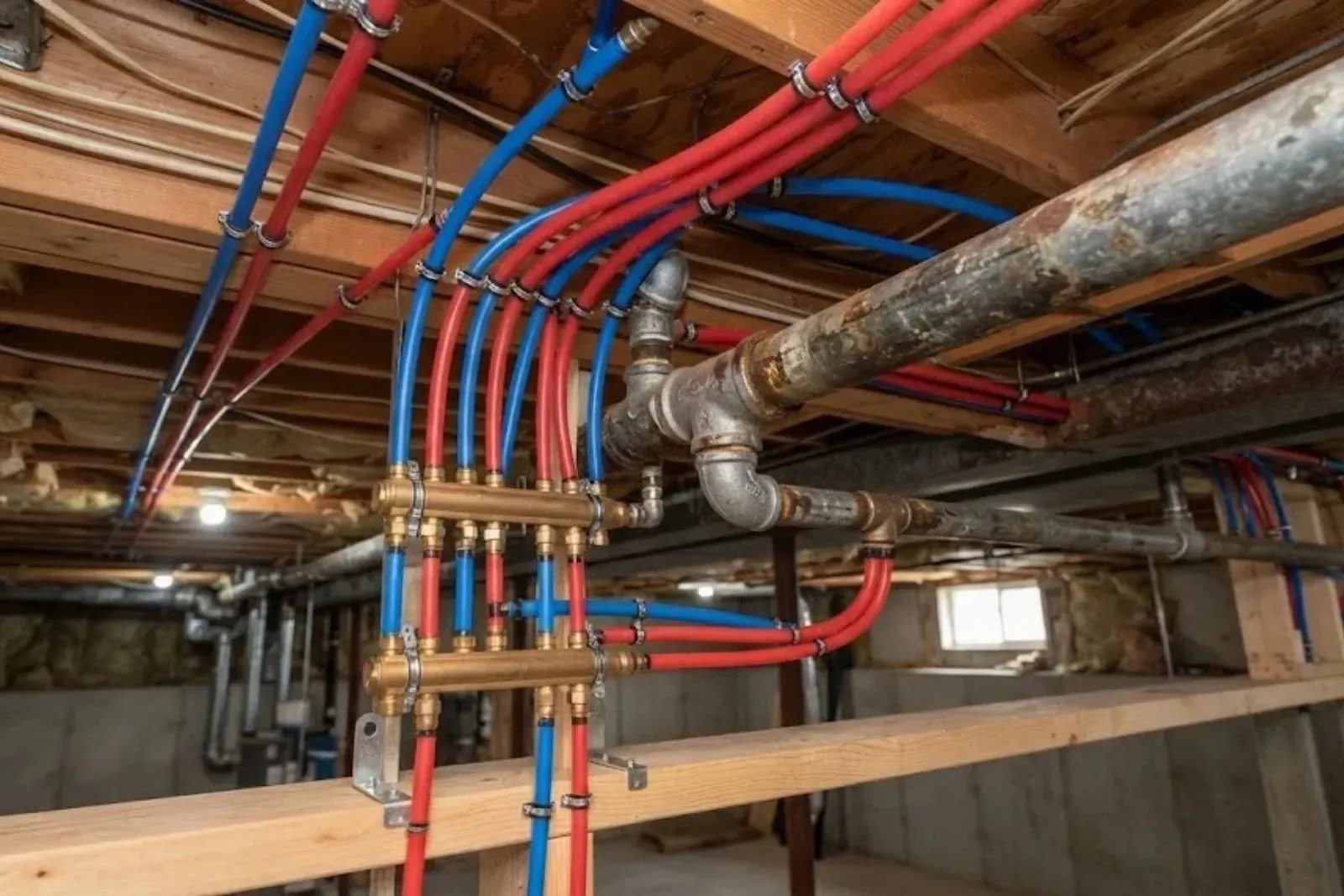
Older house, older pipes: what the year your home was built suggests
Pipe materials follow construction eras. Houses built through the middle of the last century often have galvanized steel supply lines. Later homes may have copper, and some have polybutylene, a flexible gray plastic pipe associated with fitting failures. Newer work is usually PEX or copper.
Age is only a hint, because remodels mix materials. A 1950s home might have copper in the kitchen and galvanized in the basement. The Park Ridge city page on lead service lines says homes built before 1986 are more likely to have lead service lines, which is a reason to look at the pipe where water enters, not just inside the walls.
Signs the supply pipes are wearing out
Brown or rusty water
Orange or brown water when a tap first opens, especially after a quiet stretch, can mean corroding steel.
Falling pressure
Mineral and rust buildup narrows old pipe, so showers weaken and two fixtures cannot run together.
Pinhole leaks
Tiny sprays or green crusting on copper, or repeated weeping at joints, show metal is thinning. A leak detection visit can confirm where.
Frequent repairs
Fixing one leak and finding another a few feet away is a pattern, not bad luck.
Stains on ceilings
Hidden drips leave rings on drywall long before a pipe fails outright.
Metallic taste
Water that tastes of metal after sitting overnight can point to the pipe, not the supply.
Material, typical trouble, and what to expect
| Existing pipe | How it tends to fail | Common direction |
|---|---|---|
| Galvanized steel | Corrodes from the inside, narrows, rusts the water | Replace with PEX or copper |
| Polybutylene | Fitting failures and sudden leaks | Replace the whole system |
| Older copper | Pinholes or leaks at joints, depending on the water and the pipe | Spot repair or repipe if leaks repeat |
| Mixed materials | Joints between metals corrode | Repair near the failure, plan a staged repipe |
| Lead (service line) | Not an interior repipe issue, check at the entry | Ask Public Works, see water service line repair |
Pipes older than the paint?
Tell us the age of the house and what you see at the water heater, and we will talk through repair versus repipe.
Galvanized pipe replacement
Galvanized pipe is steel coated with zinc, and the coating wears away over decades. Rust forms inside, flow shrinks, and the pipe can leak at threaded joints. The pipe can look sound outside while being nearly closed inside.
A plumber can cut a short piece out to see the inner wall. If it is heavily scaled, patching one leak tends to move the next failure to the weakest joint nearby. At that point a staged or whole-house repipe is usually the more honest recommendation. Rust-colored water that remains after the pipe is replaced is a different question, and water softener and filtration covers filtering.
PEX or copper for the new run
PEX tubing
- Flexible, so it snakes through walls with fewer cuts and fittings.
- Handles cold better than rigid pipe, though no pipe is freeze-proof.
- Usually less disruptive to install.
- Needs approval for use, which we confirm with the Building Department.
Copper
- Long track record and familiar to inspectors.
- More joints and soldering, so more time and heat in the walls.
- Can still pinhole in some water conditions.
- Often preferred where pipes stay exposed, such as a basement ceiling.
Staged repipe or whole house at once
Staged, floor by floor
- Spreads the work and the disruption over several visits.
- Lets you live in the house between phases.
- Old and new pipe share the system for a while.
- Works well when a basement run is the worst part.
Whole house in one project
- One round of wall access and one round of patching.
- No mixed metals left behind.
- Most disruptive for a few days.
- Best when leaks are showing up in several rooms.
Wall access, patching, and how disruptive it gets
Most repipes run new lines through basements, crawlspaces, attics, and closets, then open small sections of drywall where a pipe has to drop into a wall. A plumber can often reuse chases that already exist. Cabinets under sinks and tub access panels are common entry points.
You will likely have no water for part of each working day, so plan showers and laundry around it. Dust, holes, and open ceilings come with the job, and drywall patching is often a separate trade. A whole-house repipe usually takes days, not hours, and a staged job stretches across several visits.
Permit and inspection under Article 15
The Park Ridge city FAQ says Article 15 of the Municipal Code requires a permit for plumbing installations or alterations, and written permission from the Building Department before any material change. A certificate of inspection and approval is required before the new system is used. New fixtures or lines added during the same project fall under plumbing installation. Permit rules vary by job, so we confirm with the Park Ridge Building Department.
What shapes the price of a repipe
A repipe is priced by the house, not by the foot, and two homes of the same size can differ a lot. For your real number, call our 24/7 line.
Homeowner policies generally cover sudden water damage from a pipe that bursts, but they usually do not pay to replace worn pipe on purpose. Ask your insurer whether a leak claim affects renewal, and keep photos of any damage.
Before you schedule a repipe
- Note where you have seen leaks, stains, or weak pressure and photograph them.
- Find the main shutoff and check that it turns fully.
- Ask what existing pipe you have by looking at the basement lines near the water heater.
- Decide whether you want staged or whole-house, and tell us your calendar limits.
- Clear access to the water heater, the main, and any panels in walls.
- Ask who handles drywall patching and painting after the plumbing is done.
Park Ridge note: a city of owner-occupied houses
The city community profile counts 14,384 housing units in Park Ridge, with 82.8 percent owner occupied and 77 percent single-family detached. Most repipes here are therefore decisions about a home someone intends to keep, which favors replacing a failing run once rather than patching it for years.
Park Ridge buys its water from Chicago, and the 2020 report lists no lead or copper results above the action level at 30 sample sites. The city report does not publish a hardness figure, so ask for the annual water quality report and test your tap if you are weighing copper. The report also advises flushing the tap after water sits for several hours.
Permits and code for a repipe
A repipe is an alteration, so it falls under the Illinois Plumbing Code, 77 Ill. Adm. Code 890. According to the City of Park Ridge resident FAQ, Article 15 of the Municipal Code requires a permit for all plumbing installations or alterations. The city FAQ also calls for a certificate of inspection and approval before a new plumbing system is used, so plan for an inspection before the walls are closed.
Frequently asked questions
Yes. Our dispatch line is open 24/7, and non-urgent jobs like a repipe can be scheduled for evenings or weekends when available. If a pipe is actively leaking, tell us so it is handled first.
Usually not, but expect no water for part of each working day and some dust and noise. People with young children or health needs often arrange to stay elsewhere for a night or two during the main cutover.
One leak on sound pipe is usually just a repair, and a sudden split is burst pipe repair. Several leaks in a short time, or galvanized pipe that is closing up inside, argues for a repipe.
Small access holes are cut where a pipe drops through a wall. Basement and crawlspace runs avoid most cutting. Drywall patching and paint are usually separate from the plumbing, so ask who handles them.
Give tenants written notice of water shutoffs, plan work unit by unit when you can, and tell us which units have recurring leaks. A staged plan usually works better in an occupied building.
No. A repipe covers pipes inside the house. The underground line from the buffalo box to the building is a separate job.