
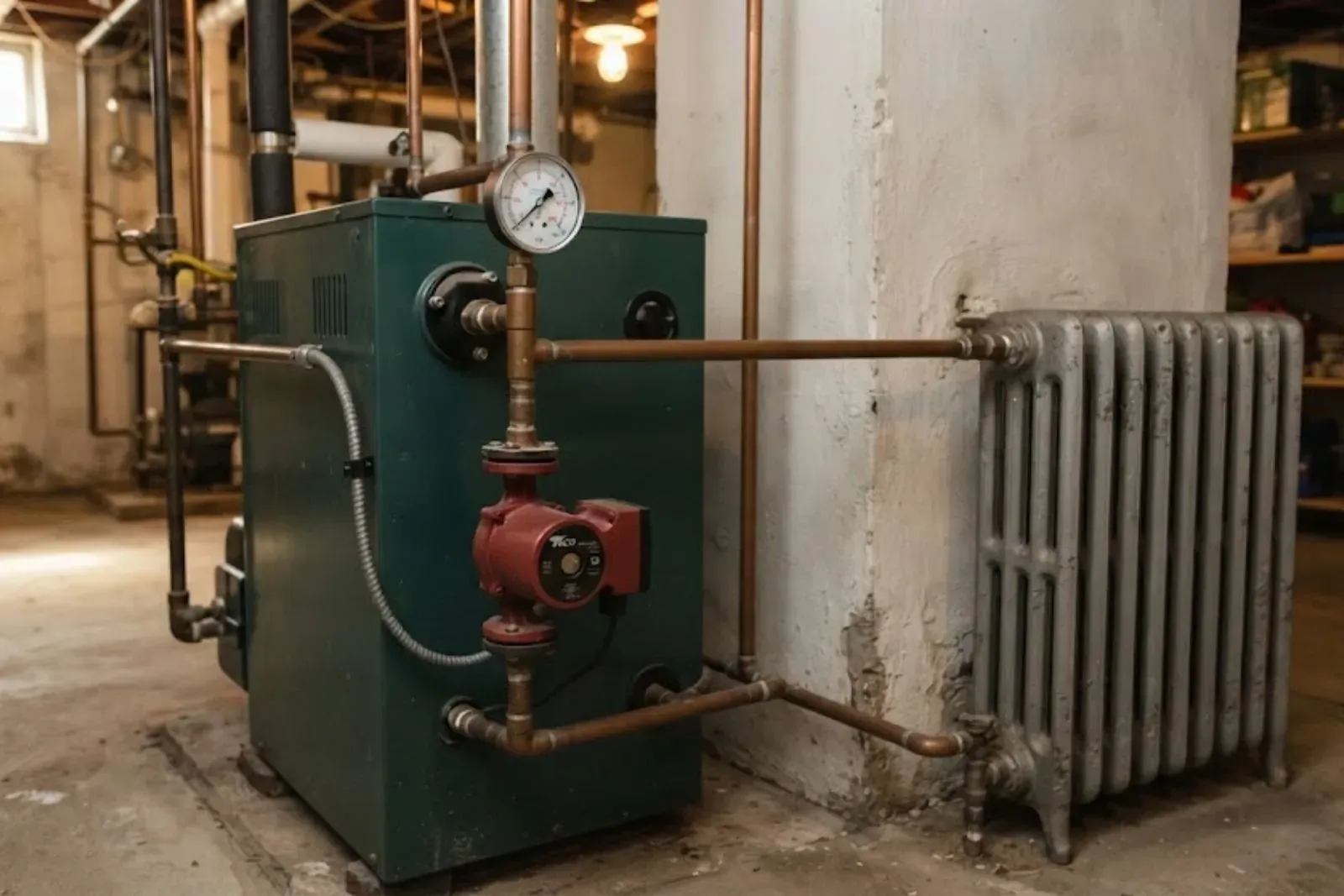
When the heat goes out on a Chicago-area winter night
Park Ridge sits in USDA Plant Hardiness Zone 5b, and the Cook County hazard mitigation plan notes winter storms that can drop more than 10 inches of snow. A boiler that quits in that weather puts pipes at risk, because a house with no heat can cool fast.
That is why we treat no-heat calls as urgent. Our dispatch runs 24/7, and same-day appointments are offered when available. If the heat has been out for hours and outdoor temperatures are well below freezing, tell us when you call so we can plan around pipe protection.
No heat right now: what to do first
A boiler problem becomes dangerous in two ways: carbon monoxide from a faulty gas burner, and burst pipes in a cold house. The first needs you out of the house, the second needs warmth and water control.
If you smell gas, go outside and call 911 or your gas utility before you call us.
- If a carbon monoxide alarm sounds or anyone feels dizzy or sick, get everyone outside and call 911.
- Do not relight a boiler that keeps shutting off.
- Close the shutoff on the boiler's water feed line if water is leaking from the unit.
- Turn thermostats up and open cabinet doors under sinks on exterior walls to keep pipes warmer.
- Use safe supplemental heat only, never an oven or a gas range for warmth.
- Call our 24/7 line and describe the gauge reading and any noises.
Before you call: five quick checks
These take a few minutes and sometimes solve the problem.
- Check the thermostat: it should be set to heat, with the setpoint above the room temperature and fresh batteries if it uses them.
- Check power: the boiler's switch, the service switch near it and the breaker should all be on.
- Read the pressure gauge and compare it with the range in the manual or on the boiler's label. Note the number.
- Look for water on the floor, around the relief valve discharge pipe and around the circulator.
- Check whether radiators or baseboards are cold in all zones or only some.
- Look at the display or lights on the boiler and write down any error code.
House losing heat?
Tell us the gauge reading, any noises and any leaks.
Common boiler failures and who fixes them
Boilers sit between plumbing and heating trades, so the table is honest about both.
| What you notice | Likely cause | Who usually handles it |
|---|---|---|
| Pressure gauge reads low, radiators cold on upper floors | Water loss from a leak, a failed fill valve or air in the loop | Plumber: leaks, fill valve, air removal |
| Pressure climbs high and the relief valve drips | Failed or waterlogged expansion tank, or a bad fill valve | Plumber: expansion tank and relief valve |
| Boiler fires but some or all zones stay cold | Failed circulator pump or zone valve | Plumber: circulators and zone valves |
| Boiler will not start, display shows lockout | Ignition, flame sensor, gas valve or control fault | Often a heating contractor for burner and combustion work |
| Banging, whistling or gurgling in the pipes | Air in the system, low water or sediment | Plumber, sometimes with a heating contractor |
| Water around the base of the unit | Leaking fitting, relief valve, or the boiler's heat exchanger | Plumber to find the source, replacement if the vessel failed |
Hydronic and steam: what differs
Hot water (hydronic) systems
- A pump circulates heated water through pipes to radiators or baseboards.
- An expansion tank absorbs pressure changes as the water heats.
- Zone valves open and close to heat different parts of the house.
- Low pressure is the classic warning sign.
Steam systems
- Water boils into steam that rises to radiators and condenses back.
- Water level in the boiler is critical, and a low water cutoff protects it.
- Radiator air vents and traps fail and cause noise and uneven heat.
- Boiler water is tested and drained on a schedule to remove sediment.
Carbon monoxide and gas safety
The Consumer Product Safety Commission (cpsc.gov) says to have a professional inspect all fuel-burning heating systems every year, and to place carbon monoxide alarms in hallways near sleeping areas, with batteries checked monthly. A boiler that cycles, soots or smells off deserves a visit before the next cold snap.
If you smell gas, or an alarm sounds and you feel ill, leave the house first and call 911 or the gas utility. Do not wait for us. Once the building is safe, call and we will schedule the repair.
What a plumber handles, and where a heating contractor comes in
Plumbers handle the water side: leaks, circulators, expansion tanks, relief valves, fill valves, zone valves, air removal and piping. Those are the most common reasons a boiler loses pressure or fails to move heat, and they are the focus of our work.
Burner assemblies, gas valves, heat exchanger replacement and combustion testing may need a heating contractor or the boiler manufacturer's service network. We say so on the phone and on site, rather than guess, and we coordinate with the right trade when the repair crosses over. If the boiler vessel itself leaks, replacement may beat repair, the same logic we apply to water heater replacement.
Expansion tanks, pumps and valves in more detail
An expansion tank holds a cushion of air behind a diaphragm. When the diaphragm fails, the tank fills with water and the system pressure spikes with every heating cycle, which trips the relief valve. Replacing the tank and checking the air charge fixes it in many cases.
A circulator pump can seize, leak at its flanges or run without moving water. Zone valves can stick closed, leaving one area cold while the rest heats. Each is a replaceable part, and testing the zone and the pump motor tells us which one failed.
Keeping the boiler running through winter
A yearly service before heating season catches small faults. That includes checking system pressure, bleeding air, testing the relief valve, inspecting the expansion tank and looking at the venting and burner. The burner part of that service is typically done by a heating contractor.
Between visits, keep the area around the boiler clear, watch the gauge each month and keep an eye out for rust stains or drips. Small drips at a valve stem are easy to fix. The same drip left for a season can corrode fittings. Leaks that hide behind walls need leak detection to find. Boiler piping and radiators also tie into general plumbing installation work when a system is changed.
Park Ridge note: permits and frozen pipes
According to the City of Park Ridge FAQ, Article 15 of the Municipal Code requires a permit for plumbing installations or alterations, and a building permit for work on water supply, plumbing and sewer piping. Replacing a circulator is not the same as moving boiler piping, so we confirm with the Park Ridge Building Department what your job needs.
If the heat fails long enough for pipes to freeze, the next call may be burst pipe repair. Learn where your main shutoff is before winter, because the city FAQ notes that after-hours street shutoff goes through the Police Department non-emergency line, which is slower than your own valve.
What decides the cost of boiler repair
A circulator swap and a failed boiler vessel are far apart in cost. We find the fault first and then quote. For your real number, call our 24/7 line.
Home insurance often covers sudden water damage from a failed pipe or fitting, but not the boiler's wear and tear. Photograph the unit, gauge and any damage. Landlords should check their lease and local rules on tenant heat.
Frequently asked questions
Yes. Our dispatch line is open 24/7, including nights and weekends. For a no-heat call, tell us the gauge reading, any leaks and whether anyone smells gas. Gas smells go to 911 or the gas utility first.
It varies by system, so use the range printed on the boiler or in its manual. A reading far below it, or one that climbs and trips the relief valve, deserves a call.
Common causes are a leak somewhere in the loop, a failed fill valve, a bad expansion tank or a relief valve that is letting water out. A plumber can pressure-test the system to find which.
Those jobs may need a heating contractor. We tell you early, and we handle the water side: pumps, tanks, valves and leaks.
A small drip at a valve can wait for a visit if you watch the pressure. A steady leak, a smell of gas or a lockout should be treated as urgent.
Call our 24/7 line with the address and boiler type. We attend to the plumbing side and coordinate a heating contractor when the repair requires one.
The CPSC recommends a professional inspection of fuel-burning heating systems each year. Schedule it before the heating season starts.