
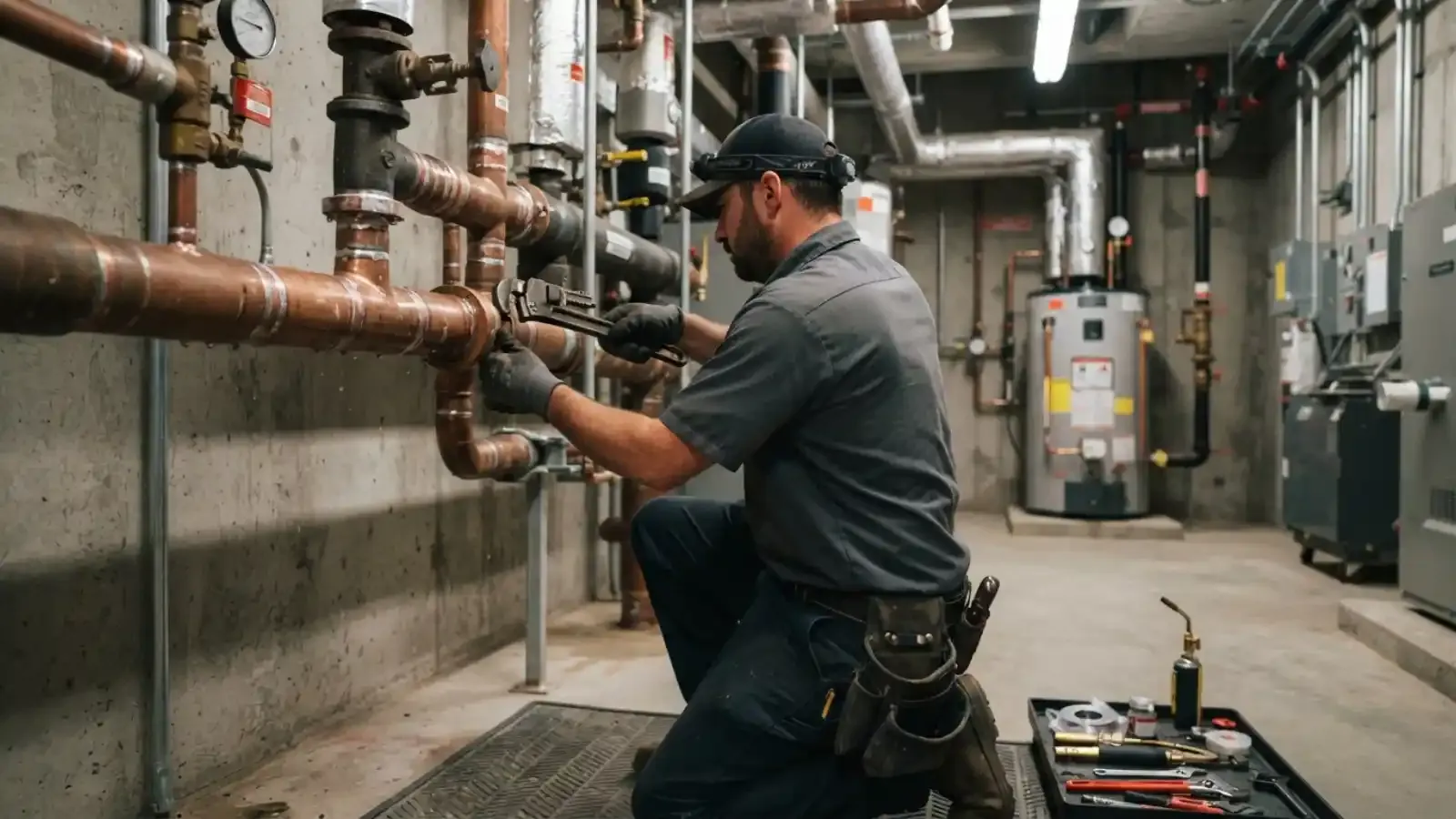
Uptown, Northwest Highway, and Touhy: where commercial calls come from
Park Ridge's commercial plumbing sits mostly along a few corridors: the Uptown area near the Metra station, Northwest Highway, and Touhy Avenue, plus Busse Highway and Dee Road. Buildings there range from storefronts with one restroom to multi-tenant buildings with shared drains.
Employers include a hospital, a school district, and municipal and park buildings, according to the city's community profile. We use that only as context: larger buildings have more fixtures and longer drain runs, which changes how a leak or backup spreads between floors.
Commercial problems we get called for
Restroom stoppages
Overflowing toilets, slow urinals, and floor drains in public restrooms.
Floor drain backups
Standing water or sewage coming up at kitchen, mechanical, or restroom floor drains.
Water leaks
Supply or drain leaks that wet ceilings, storage, or a neighbor tenant's space.
No hot water
Tank or heater failure that stops dish machines, handwashing, or showers. See water heater repair.
Grease buildup
Kitchen lines and traps that clog with fat and slow the drains behind them.
Shutoff trouble
A main valve that will not close, or shared valves that lock out other tenants.
Emergency commercial plumbing: what to do on an after-hours call
A flooded restroom at night cannot wait for opening hours. Our 24/7 dispatch handles after-hours and weekend calls for commercial properties, and the first few steps below keep the damage from reaching other tenants.
- Shut the valve under the fixture, or the building main if water is spreading.
- Stop using restrooms and sinks that share the clogged drain.
- Keep staff and customers out of wet areas and away from electrical panels.
- Call the property manager or landlord, since shared lines are often their call.
- Move inventory and records off the floor and photograph the damage.
- Tell dispatch your building type, the floor, and who holds the keys.
Locked out of the building after hours?
Give dispatch the property manager's contact, and we will coordinate access before heading over.
Commercial leak detection: what we can and cannot do
Finding a leak in a commercial building uses the same ideas as in a house: listening, pressure testing, moisture mapping, and thermal imaging. We can usually help with ordinary plumbing leaks in small commercial and mixed-use buildings. Our leak detection page describes the methods in plain terms.
Some work is outside what a general plumber should promise. Fire sprinkler mains, large underground utilities, and multi-building campuses often need specialists, and some calls turn out to be a landlord's shared line. We would rather tell you that on the first call than dispatch a truck that cannot finish the job.
Grease trap cleaning
Restaurants and food service kitchens use grease traps or interceptors to catch fat before it enters the sewer. When a trap fills, drains slow, odors rise, and the line behind it can clog. Small under-sink traps are routine plumbing work. Large in-ground interceptors are usually pumped by a hauler.
Local rules may set a pumping schedule, so ask the Park Ridge Building Department or Public Works what applies to your kitchen. Tell us the type and size of your trap when you call, and we will say whether it is something we handle or something a hauler should. If the line behind the trap has clogged, that falls under drain cleaning.
Backflow testing: ask your water provider
A backflow assembly sits on the water line to stop used or contaminated water from flowing backward into the supply. Many commercial buildings have one on fire lines, irrigation, boilers, or a kitchen. Whether it needs yearly testing, and who may do the test, is set by the local water provider, not by the plumber.
So the first step is to ask the water provider for your building. Park Ridge buys its water from Chicago and the City handles billing and meters, so start with Public Works. If your notice says a test is due, share it with us. We will say what we can do and what a separately credentialed tester should handle.
Floor drains and restrooms
Floor drains in commercial buildings catch equipment overflow, kitchen washdown, and sometimes sewer backup. A drain that smells or gurgles may have a dry trap, a clog, or a main line problem. Pouring water into a rarely used drain refills the trap seal and can stop sewer gas.
Public restrooms bring heavy use. Flushable wipes, paper towel, and the occasional toy cause most stoppages. A slow flush in a single stall is usually local, and several fixtures backing up together means the building drain. See sewer line cleaning when more than one fixture is affected.
Tenant, landlord, or building manager: who handles what
Leases differ, so check yours. This is the usual pattern.
| Situation | Who usually decides | What to tell dispatch |
|---|---|---|
| Fixture inside a tenant's suite | Tenant, under the lease | Suite number, fixture, and whether water is spreading |
| Shared drain or main | Landlord or property manager | Which tenants are affected and who holds the keys |
| Water in a neighbor's space | Landlord, with tenant notice | Where the water started and who has access |
| After-hours access | Building manager | A contact who can open the building |
| Repeat leaks | Landlord, often with the owner | Dates and photos of earlier leaks |
What shapes the price of a commercial plumbing call
Business calls vary more than home calls because of building size, access, and who must authorize the work. For your real number, call our 24/7 line.
Commercial property and business-interruption policies differ widely. Many cover sudden water damage but not the worn pipe, and sewer backup often needs an endorsement. Ask your agent and your landlord's insurer who covers what.
Park Ridge note: permits and the corridors
The city lists permits and inspections for businesses through its Community Preservation and Development department, and Article 15 of the Municipal Code requires a permit for plumbing installations or alterations. If a repair becomes a rebuild of fixtures or drains, check with the Building Department first.
Park Ridge is about 14 miles northwest of downtown Chicago and about 2 miles east of O'Hare. The harder part of an after-hours call is usually access, so we coordinate with managers and tenants before heading out.
Frequently asked questions
Yes. Our 24/7 dispatch takes commercial calls overnight and on weekends. Give us the address, the floor, and a contact who can open the building, and we will say what to shut off first.
Usually the landlord or property manager, since shared lines serve several tenants. Check the lease, and tell us who can approve the work when you call.
Testing rules are set by the local water provider, so ask them whether yours is due and who may do it. Share the notice with us and we will say what we can handle.
Small traps are routine plumbing. Large in-ground interceptors are usually pumped by a hauler. Describe yours and we will say whether it is ours to do.
Often, for ordinary plumbing leaks. Fire mains, large underground utilities, and campus-wide lines may need specialists. Tell us what you know and we will be honest about the fit.
A dry trap is a quick fix, but a drain that gurgles or backs up can signal a main line problem. If water is rising, treat it as urgent.