
Park Ridge note: what the flood record says about basements here
The Cook County Multi-Jurisdictional Hazard Mitigation Plan annex for Park Ridge reports that nearly 500 basements flooded on July 23, 2011. April 2013 flooding was federally declared (FEMA DR-4116), and a flash flood on August 7, 2018 caused $100,000 in reported property damage. The plan blames much urban flooding on the city's antiquated combination sewer system and says flooding vulnerability has increased.
A combination sewer carries storm runoff and household wastewater in the same pipe, so a heavy rain can fill it faster than it drains. For a homeowner, that makes backup protection part of any waterproofing plan, alongside the groundwater side. The plan also lists 17 FEMA repetitive-loss properties, which shows that the same buildings can flood more than once.
The city's stormwater page describes a Stormwater Master Plan presented to City Council on February 12, 2018, and a stormwater utility fee based on runoff from each parcel. A 2021 city notice also described a large underground detention vault under the Marvin Parkway median between Seminary and Wilkinson, with sewer and water main work.
Public projects like these can help over time, but they do not replace protection inside your own house. Ask Park Ridge Public Works whether any flood protection assistance applies, because programs change.
Three different sources of basement water
Surface water and groundwater seepage come from outside. Rain that pools against the foundation, a high water table, or a window well that fills can push water through cracks, the joint where the floor meets the wall, or a window. This water tends to show up near walls, at the floor edge or at window wells, and it is the kind most waterproofing methods address.
Sewer backup comes up through floor drains, a basement toilet or a shower, often in a storm when the public sewer is full. This is wastewater, not groundwater, and no drain tile or sealant stops it, and sewer line cleaning only clears the line afterward. A backwater valve or an overhead sewer does.
Plumbing leaks come from inside the house: a failing water heater, a supply line, a drain pipe or a service line. These can mimic seepage because they leave wet floors, but they follow the water system, not the weather. If the floor is wet on a dry week, start with leak detection before you pay for waterproofing.
Symptom, likely source and first fix
Match what you see to the most likely source. This is a starting point, and a plumber can confirm the source on a visit.
| What you see | Likely source | First fix |
|---|---|---|
| Damp wall or puddles along the wall after a hard rain | Surface or groundwater seepage | Clear gutters, extend downspouts and check the grade, then ask about drain tile and a sump |
| Water at the floor and wall joint that rises with rain | Rising groundwater | Interior drain tile that drains to a sump pit with a working pump |
| Floor drain bubbling or sewage-smelling water in a storm | Sewer backup | Stop using water, then discuss a backwater valve or overhead sewer |
| Water at a window well | Overflowing well or failed drain | Clear the well, add a cover, check the well drain |
| Wet floor on a dry week | Plumbing leak | Close the main, check meter movement and call for leak detection |
| Sump pump runs constantly or never runs | Stuck float, failed pump or high water table | Test and repair or replace the pump, add a battery backup |
Planning for storm season?
Call our 24/7 line and we will walk through your basement's water sources with you.
Exterior waterproofing or interior drain tile
Exterior waterproofing
- Excavates down the outside of the wall to coat or wrap it and expose the footing drain.
- Keeps water from reaching the wall at all.
- Disturbs landscaping, patios and sometimes walkways.
- Is excavation and foundation work, so it belongs to a waterproofing or foundation contractor.
Interior drain tile and sump
- Cuts a channel at the floor edge for perimeter drain pipe that carries water to a sump pit.
- Manages water after it reaches the wall instead of stopping it outside.
- Causes less disruption outside the house.
- Depends on a working pump, so power loss or a failed pump can undo it.
Gutters, grading and window wells come first
Many wet basements start with where roof water goes. Gutters that overflow and downspouts that end at the foundation put a large volume of water against the wall every time it rains. Extending the downspouts well away from the house, keeping gutters clean and making sure the ground slopes away from the foundation cost far less than any system below ground.
Window wells collect leaves and rain. A cover keeps debris out, and a drain at the bottom of the well, connected to the footing drain, carries away what gets in. If a window well fills and spills into the basement during storms, fix it before a drain tile project, since it may be the main entry point. Regrading and large yard changes are work for a landscaper or excavator, not a plumber.
Sump pits, pumps and the plumber's part of the job
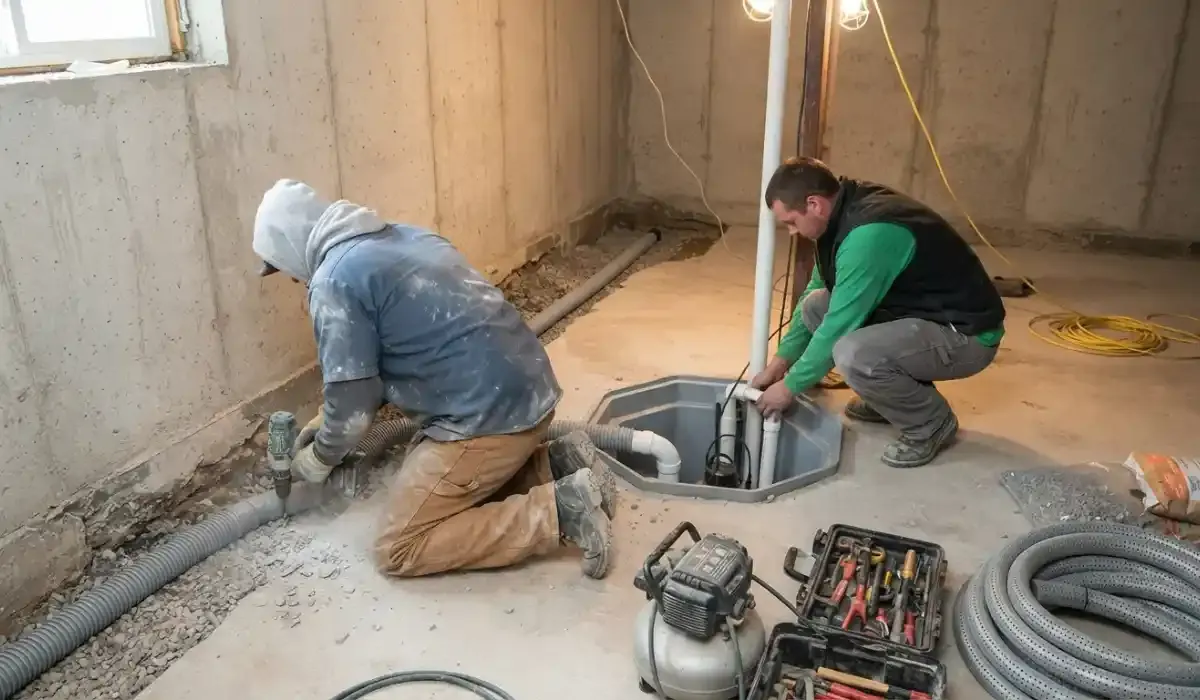
A sump pit is a basin in the floor where drain tile collects water, and a pump lifts it out through a discharge pipe to a place away from the house. The pump is the weak link, which is why batteries, backup pumps and a clear discharge route matter. Our plumbers replace and repair pumps, set the discharge, and connect the pit to the drain tile, as covered under sump pump repair.
A sump pump moves groundwater and clear water, not sewage. A basement that fills during storms through a floor drain needs a different answer, covered in the next section.
Backwater valves, floor drains and overhead sewers
A backwater valve is a check valve installed in the building drain. It lets wastewater flow out of the house and closes if the flow reverses. It protects only the fixtures connected downstream of it, so basement fixtures are the ones it guards, and it needs periodic cleaning to stay free of debris. Some floor drains also have a float or a threaded plug that stops reverse flow.
An overhead sewer is a different approach. Basement fixtures drain into a sealed pit with an ejector pump, which lifts the wastewater above the level of the street sewer, so a backup cannot enter the basement through a floor drain. It is a bigger project than a backwater valve and needs power and maintenance.
This is a planning conversation. The right choice depends on your plumbing layout, how the basement is used and your budget. Installing either one is a plumbing alteration, and the Park Ridge municipal code requires a permit for plumbing installations or alterations. We confirm what applies with the Park Ridge Building Department. If you want to see the condition of the pipe first, a sewer camera inspection shows what is in the line.
What a plumber handles and what a waterproofing contractor handles
Plumber
- Sump pit, pump, discharge line and battery backup.
- Connecting drain tile to the sump.
- Backwater valves, floor drain backflow protection and overhead sewers.
- Finding leaks and clearing or inspecting the sewer line.
Waterproofing or foundation contractor
- Excavation and exterior membrane work.
- Crack injection and wall or floor sealing.
- Structural repair of the foundation.
- Regrading and yard drainage with an excavator.
Storm-season prep for a Park Ridge basement
A few checks before heavy rain cost nothing and show you where the weak points are.
- Pour a bucket of water into the sump pit and watch the pump turn on and empty it.
- Check that the discharge pipe is clear and ends away from the house.
- Clean gutters and extend downspouts away from the foundation.
- Clear window wells and cover them, and check the well drain.
- Know where your main water shutoff and breaker panel are.
- Move valuables and stored boxes off the basement floor.
- Read your homeowner policy for water backup coverage and photograph the basement while it is dry.
What decides the cost of basement water control
A downspout extension and an exterior excavation are both called waterproofing, but they sit at opposite ends of the scale. For your real number, call our 24/7 line.
Many homeowner policies exclude groundwater seepage, and sewer or sump backup usually needs a separate endorsement, so read your policy before a storm. Flood damage from rising water outside the house is normally a separate flood insurance matter.
Rules that apply to waterproofing work
Waterproofing is not always plumbing, so ask who is responsible for each part of the job. According to the City of Park Ridge resident FAQ, Article 15 of the Municipal Code requires a permit for all plumbing installations or alterations. Anything that touches drain tile, sump discharge or a floor drain connection falls on the plumbing side, and a licensed plumber should handle it.
Frequently asked questions
Yes. Our dispatch line is open 24/7, and we schedule planning visits at times that fit your day. If water is entering now, tell us on the call and we will treat it as an urgent visit.
We could not confirm a city rebate or assistance program, so we do not claim one. Ask the Park Ridge Public Works department what is available, since programs change.
Seepage is usually clear water along walls or at the floor edge. Backup comes up through a floor drain, toilet or shower and may smell like sewage. Stop using water if you see backup and call.
No. A sump pump moves groundwater from a pit. Sewage coming back up the building drain needs a backwater valve or an overhead sewer.
Park Ridge's code requires a permit for plumbing installations or alterations, and rules vary by job. We confirm with the Park Ridge Building Department before we start.
Document when and where the water appears, then call us to find the source. We will tell you whether the plumbing side or a waterproofing contractor is the right next step.
It often helps a lot when roof water was the cause, and it costs less than any underground work. It does nothing for sewer backup or a plumbing leak.