
When a clogged drain is an emergency
Most clogs are a nuisance. A sink that drains slowly can wait for the next morning. Some clogs cannot wait: water that is rising toward the rim, a floor drain that gurgles and spills, or a washing machine that pushes water back out of its standpipe.
Treat it as urgent if more than one fixture is affected at once, if wastewater smells like sewage, or if it is coming up in the lowest part of the house. That pattern usually points past the fixture to a shared drain line, and every flush or load of laundry adds more water to the problem.
Drain backing up right now: what to do while we are on the way
A few minutes of care can keep a bad clog from becoming a flooded floor. None of this fixes the blockage, but it limits the damage until a plumber can reach the line.
- Stop running water everywhere: no laundry, dishwasher, showers or flushing.
- Put a bucket or towels around the overflowing drain and keep children and pets away from standing water.
- Do not pour drain cleaner into a drain that is already full, because the chemical sits in the water and can splash on you or a plumber.
- Turn off power to a flooded area only if you can reach the panel while staying dry. Otherwise stay out and tell us.
- Note which fixtures are slow or backing up and in what order. That tells the plumber where the blockage likely sits.
- Call our 24/7 line and describe what you see.
What your drain is telling you
Where the water goes wrong says a lot about where the clog is. Use this as a rough map, not a diagnosis.
| What you see | Likely location | What happens next |
|---|---|---|
| One sink or tub drains slowly | Trap or branch line near that fixture | A hand tool or small cable usually clears it from the fixture or a nearby access point. |
| Two fixtures in the same bathroom are slow | Shared branch line | A cable is run through the branch, often from a cleanout or a removed trap. |
| Water from an upstairs bath shows up in a lower sink or tub | Main drain below the branches | The plumber works from a cleanout or roof vent to reach the main drain. |
| Washer standpipe overflows | Laundry drain or main drain | Lint and soap buildup is cleared, and the line is checked for a deeper blockage. |
| Basement floor drain bubbles or spills | Main drain or sewer lateral | A larger machine and a camera may be needed. See sewer line cleaning below. |
Water still rising?
Stop using the drain and call our 24/7 line. A plumber can tell you on the phone what to do first.
What actually clogs a household drain
A clog is rarely one big object. It is usually a slow build of material that was fine going down and thicker coming back up.
Grease and soap scum
Warm grease runs freely, then cools into a coating on the pipe wall that catches everything after it.
Wipes and paper products
Wipes labeled flushable often do not break up and can snag at a bend or a rough joint.
Food in kitchen lines
Rice, pasta, coffee grounds and fibrous scraps swell or pack down below the disposal.
Roots or a damaged pipe
A line that clogs again and again may have a belly, a gap or roots. A camera inspection settles it.
Drain snaking and cabling: how a cable clears the line
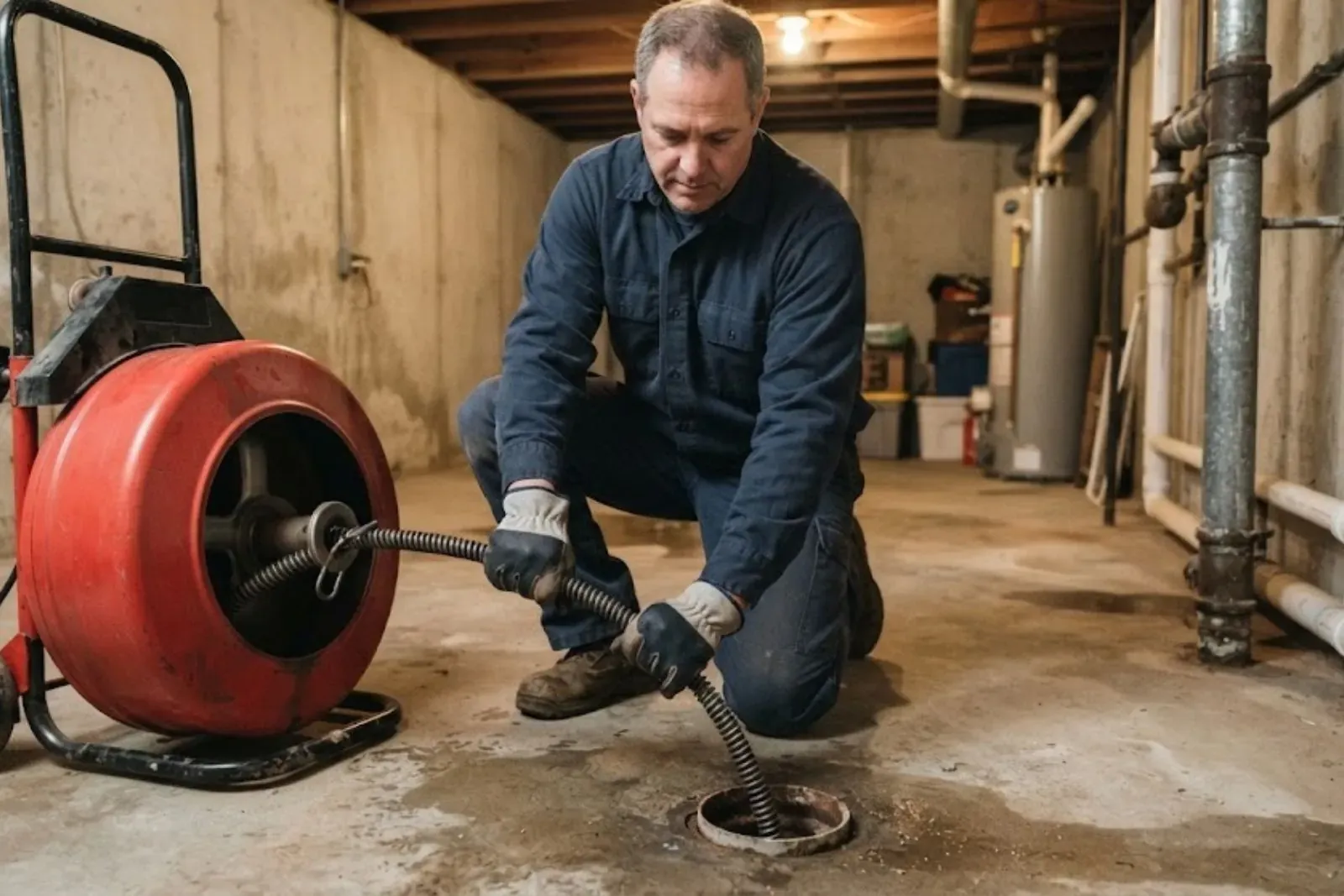
A drain snake, also called a drain cable or auger, is a flexible steel cable on a drum with a cutting or hooking head. The plumber feeds it into the drain, turns the drum, and the head either breaks up the blockage or hooks it so it can be pulled out. Smaller cables fit sink traps and tub drains. Heavier cables handle a main drain.
Cabling works well on soft blockages and on a clog sitting at one spot, such as hair near a trap. It makes a hole through the middle of a thick coating but may not scrape the pipe wall clean. If the clog comes back in a few weeks, the line probably needs more than a hole, and jetting or a camera look is the next step.
Kitchen sink clogs: grease, scraps and the disposal
The kitchen is the busiest drain in the house and the one most likely to back up into another fixture. A double sink that fills on both sides, or a dishwasher that leaves dirty water in the basin, often means the blockage sits past the sink trap, in the line leading toward the stack.
A disposal does not remove the load. It grinds scraps into small pieces that still settle in a horizontal pipe, particularly when cold water runs and the grease has hardened. If your disposal hums but does not spin, or the sink is leaking below it, see garbage disposal repair for that side of the problem.
For a kitchen line that has slowed over months, cleaning the whole branch is usually better than clearing only the clog at the sink.
Snake or jet: which tool fits which clog
Drain snake or cable
- Fast and low-cost way to open a single sink, tub or toilet line.
- Best for soft clogs, hair and objects stuck at one spot.
- Leaves a hole through grease rather than removing the coating.
- Cannot reliably clear heavy root growth, scale or long grease runs.
Hydro jetting
- Uses high-pressure water from a nozzle to scour the inside of the pipe.
- Better for grease buildup, sludge and lines that clog every few months.
- A camera check first confirms the pipe can take the pressure.
- Costs more per visit than a cable. See hydro jetting for how to decide.
Do it yourself or call a plumber
A plunger and a bit of patience are fine for many clogs. Here is where we would tell a neighbor to stop and make the call.
- Try a plunger on a single slow sink or tub first, with the overflow opening blocked by a wet cloth.
- A small hand auger from a hardware store can pull hair from a bath drain, if you can reach the trap.
- Skip the chemical drain cleaner. It can damage some pipes and finishes and is dangerous to anyone who works on the line afterward.
- Stop if the plunger does nothing after a few tries, or if the water comes back within a day.
- Call right away if two or more fixtures are slow, if a floor drain is backing up, or if you see sewage.
- Call if the clog returns in a few weeks. That points to a line problem, not a hair problem.
Drain line leaks under the floor or in the wall
A drain pipe can leak even when it is not blocked. A crack, a loose joint or a failed seal around a fixture will show as a damp ceiling below a bathroom, a musty crawl space, or a stain on a basement wall.
A leak in a drain line only shows when you use the fixture, so it can hide for months. If a drain has been cleared and water still appears below it, tell the plumber, who can test the line and, if needed, point you to burst pipe repair or leak detection.
Park Ridge note: shared sewer, private pipe
Park Ridge's hazard mitigation plan, written for Cook County, calls the city's system an antiquated combination sewer and records nearly 500 flooded basements on July 23, 2011, plus federally declared flooding in April 2013. In heavy rain, the public sewer can fill and push water back toward houses. That means a basement floor drain that backs up during a storm may not be a clog in your pipe at all.
Tell the plumber when it happens. A backup only in storms points to the public system or a missing backflow protection, while a backup on a dry day points to a blockage in your own line. The city FAQ says the homeowner repairs the sewer lateral up to the connection with the sewer main, so a house-wide blockage is your responsibility to clear. See sewer line cleaning for that case.
What decides the cost of drain cleaning
Drain work is priced by the job, not by a flat rate, because a bathroom sink and a main line are very different tasks. For your real number, call our 24/7 line.
Homeowner insurance usually does not pay to clear a clog, since that is maintenance. A sudden backup that damages floors and belongings may be covered only if you carry a water backup endorsement, so read your policy and ask your agent before a storm.
Standards behind a clean drain job
Clearing a clog is maintenance, but opening a cleanout or replacing a trap still has to meet the Illinois Plumbing Code, 77 Ill. Adm. Code 890. According to the Illinois Department of Public Health, plumbing work must be done by a licensed plumber or an apprentice working under one.
Frequently asked questions
Yes. Our emergency line runs 24/7, and when a drain is backing up into the house we send a licensed plumber as soon as the schedule allows, including nights, weekends and holidays. Tell the dispatcher which fixtures are involved.
They usually share the main drain or the sewer lateral. When both back up, the blockage is past the branches, often at the main line, and clearing one sink will not help.
Often yes. Most slow drains are a partial clog that gets worse. If it returns after a plunger, a cable or a camera look can find the cause before it turns into a full stoppage.
A tenant should tell the landlord or property manager first, since the lease usually says who pays. If it is an emergency with water rising, call us and we can help the property manager decide on the spot.
Grates are lifted and the sediment and debris below are cleared. If the grate fills again fast, ask us about the line behind it.