
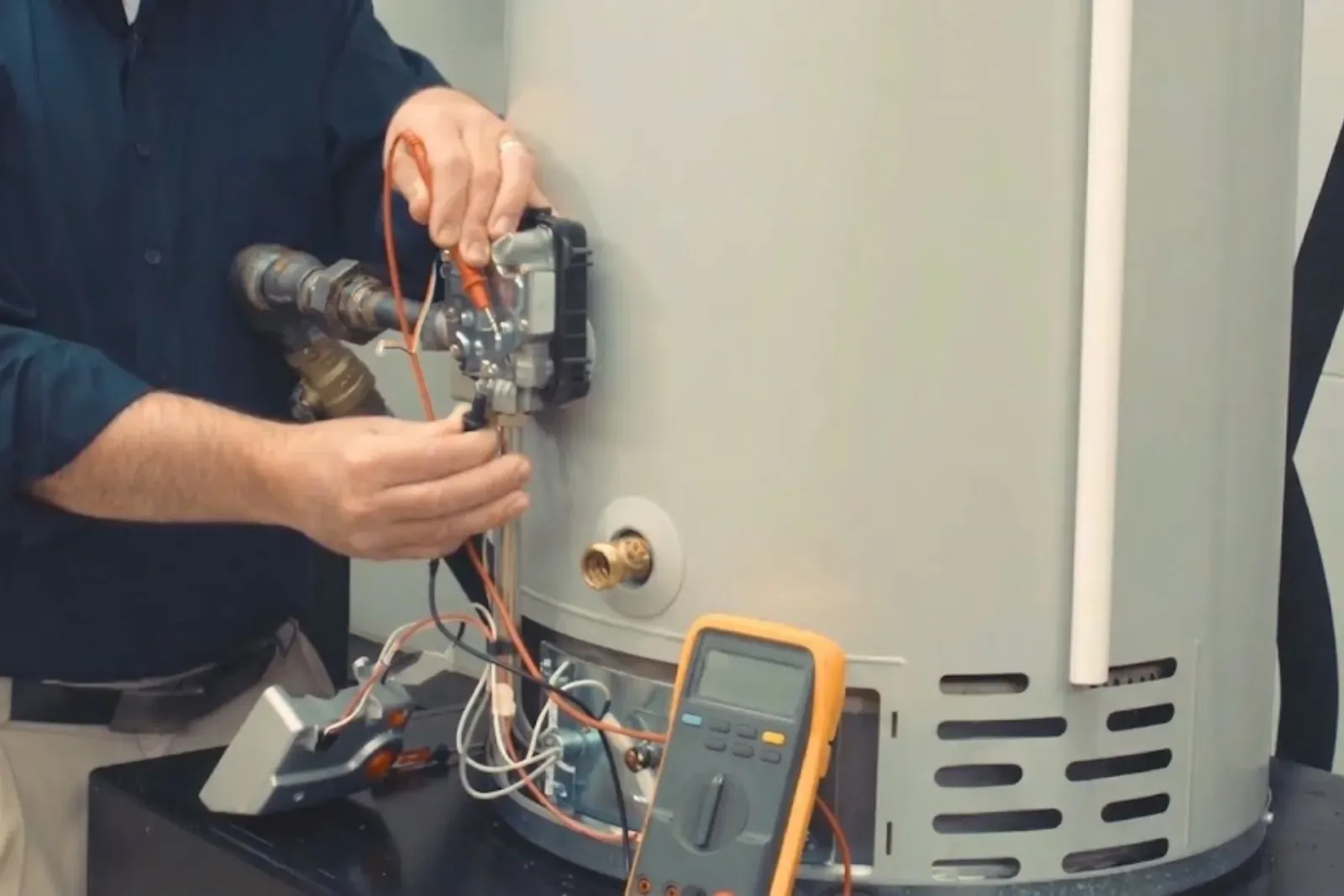
What the relief valve actually does
A tank water heater heats water and holds it under pressure. If the thermostat fails or the pressure rises, the relief valve opens before the tank is stressed. The Illinois Plumbing Code (77 Ill. Adm. Code 890, Section 890.1230, read on ilga.gov) requires water heating equipment to have either separate pressure and temperature relief valves or one combination valve.
Under that section, the temperature element must sit in the hottest water in the top 6 inches of the tank, and the temperature valve must fully open at 210 degrees F. The pressure side must open at or below the heater's rated working pressure and carries a test lever. In plain terms, one valve watches the heat, one watches the pressure, and both must be able to do their job.
The same section says there cannot be a shut-off valve between the pressure relief valve and the tank. That is why adding any valve or cap near a relief valve is a serious mistake. It turns a safety device into a decoration.
What a dripping valve is telling you
The pattern of the drip points to the cause. This is a starting point, not a diagnosis.
| What you see | Likely cause | What happens next |
|---|---|---|
| Short drips only while the heater is firing | Thermal expansion in a closed system, with nowhere for expanded water to go | A plumber checks static pressure and whether an expansion tank is needed |
| Steady drip that never stops | Worn valve seat, or house pressure running high | Test the lever, check pressure with a gauge, replace the valve if it will not reseat |
| Hot water or steam, and the tank feels very hot | Thermostat or heating element control failure | Turn off power or gas to the heater and call right away |
| Leak at the threaded joint, with rust or mineral crust | Corroded valve body or a poor connection | Replace the valve and check the tank opening for damage |
| Lever will not move, or nothing comes out when tested | Valve seized from sediment or corrosion | Do not force it. Replace the valve, since an untested valve cannot be trusted |
How to test the valve
Check the pipe
Make sure the discharge pipe is attached, points down, and ends near the floor or a drain, with nothing blocking it.
Set a bucket
Place a bucket under the open end of the pipe, keep children and pets back, and know that the water will be hot.
Lift the lever
Raise the test lever briefly, let water flow for a few seconds, then let it snap back.
Watch for drips
Look at the pipe end for several minutes and again later. A valve that keeps dripping after a test needs replacing.
Need a plumber, not a guide?
Call the 24/7 line. A licensed, insured plumber, a clear price before work starts.
The discharge pipe matters as much as the valve
Section 890.1230 also sets rules for the pipe that carries the discharge away. It must connect indirectly to waste, be metallic, slope continuously downward, and end within 6 inches of the floor or receptor. The end cannot be threaded, and there can be no reducers, valves or other restrictions in the line.
The reasoning is simple. A threaded end invites someone to screw on a cap, and a pipe that stops short of a drain can spray scalding water on a person. The code also bars routing the discharge through a wall to the outside or into a spot where it could freeze. If your pipe is missing, plastic, shortened or capped, that is a repair to schedule soon.
Safety checklist for homeowners
- Never cap, plug or add a valve to the relief valve or its discharge pipe.
- Test the lever once a year, or as your water heater manual directs.
- Keep the area around the heater clear so the pipe and valve are visible.
- Turn off the power or gas supply if water at the valve is steaming or the tank is unusually hot.
- Check the floor around the tank for rust stains or damp spots after any drip.
- Do not tighten a leaking valve with a long wrench. Over-tightening can damage the tank threads.
- Ask whether an expansion tank is present if drips happen only while the heater is firing.
Park Ridge note: permits and who you can verify
The City of Park Ridge FAQ says Article 15 of the Municipal Code requires a permit for all plumbing installations or alterations, and written permission from the Building Department before any material change. Swapping a relief valve on an existing heater is a small job, but changing a discharge pipe or adding an expansion tank is an alteration, and permit rules vary by job. We confirm them with the Park Ridge Building Department before work starts.
Because this is a safety device, check who touches it. The Illinois Department of Public Health (IDPH) licenses plumbers and offers an online lookup, so you can verify any plumber's license before they work on your heater.
Repair now or replace the heater
Replacing a worn valve is usually a small repair, and a water heater repair visit should include testing the new valve and checking pressure. If the valve drips because the tank is corroded, leaking at the bottom, or very old, a new valve only delays the real problem.
In that case, a proper water heater installation makes sense, with a new relief valve, a code-compliant discharge pipe and expansion control sized for the system. Homeowners in Glenview and Norridge call us for the same issue, and we dispatch to both towns as well as Park Ridge.
Standards and licensing for relief valve work
A relief valve is a safety device, so do not cap it or remove it. Replacement follows the Illinois Plumbing Code, 77 Ill. Adm. Code 890, and according to the Illinois Department of Public Health, a licensed plumber should do the work. Follow the manufacturer's manual for your model.
Frequently asked questions
A little water during heating can point to thermal expansion, which is common but still needs attention. A steady drip, steam, or a hot tank is not normal. Test the valve and call us if it does not stop.
No. Capping the pipe defeats the safety device, and the Illinois Plumbing Code does not allow a threaded end or valves on that line. Find the cause of the drip instead.
There is no single schedule. Replace it if it drips after testing, will not reseat, is corroded, or sticks. Your manufacturer's manual may give a testing interval, so check it.
So discharged water lands in a drain or receptor, not on a person. The state code limits the end to within 6 inches of the floor or receptor and bars a threaded end.
The city FAQ says Article 15 requires permits for plumbing installations or alterations. Whether a like-for-like valve swap qualifies depends on the job, so we confirm with the Park Ridge Building Department.
Many do. One Navien valve set manual says not to install a shut-off valve between the tankless heater and the pressure relief valve, which matches the rule for tank units.