
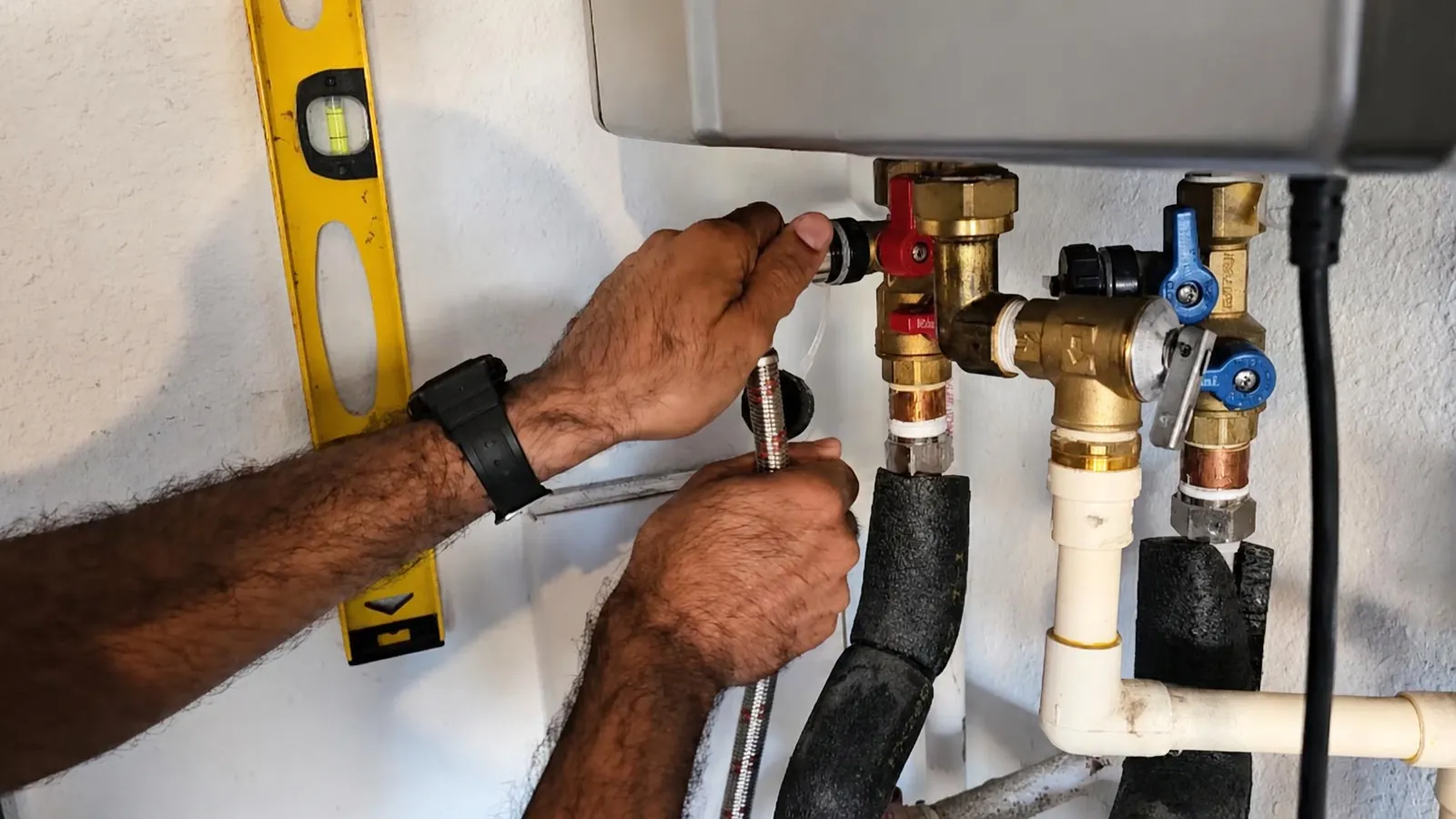
Why heated water causes a pressure problem
Water takes up more space when it is hot. In an open system, the extra volume simply flows backward into the supply main, so pressure barely changes. In a closed system, a backflow preventer or check valve blocks that backward flow and the expanded water has nowhere to go.
The State Water Heaters installation manual says it plainly: when water is heated it expands, and provision must be made for that in a closed hot water system. It adds that a precharged diaphragm tank stores the expanded water and returns it when the temperature drops. That manual is written for tank heaters, but the physics is the same for a tankless unit on a closed house.
The Rinnai tankless manual says the same thing in its own terms. It requires means to control thermal expansion when the heater sits in a closed water supply, such as one with a backflow preventer in the cold supply line. It tells the installer to contact the water supplier or local plumbing inspector on how to do that.
Is your system open or closed? A decision framework
You cannot tell by looking at the heater. These clues help you decide what to ask.
| What is on the cold supply | What it means | What to do |
|---|---|---|
| A backflow preventer or reduced pressure device on the main | Closed system. Expanded water cannot flow back | Plan for thermal expansion control, as the heater manual directs |
| A check valve or pressure-reducing valve with a built-in check | Likely closed, depending on the valve design | Have a plumber read the valve label and test for pressure rise |
| A meter with a check valve inside | Possibly closed. Ask your water supplier | Confirm with the water supplier before assuming either way |
| No devices that stop backward flow | Likely open | Still watch the relief valve and pressure gauge after install |
| Pressure gauge on a hose bib climbs when the heater fires | Closed in practice, whatever the plumbing diagram says | Add an expansion tank or other control per manual and inspector |
What the expansion tank actually does
A thermal expansion tank is a small steel tank split by a rubber diaphragm. One side holds air, the other connects to your cold water supply near the heater. When pressure rises from expanding water, the diaphragm moves and the tank absorbs the extra volume. When the water cools, the air pushes it back out.
The right size depends on the volume of water in the system, the supply pressure, and the highest temperature the water reaches. Tank makers publish sizing charts, and the air charge in the tank typically needs to match the incoming water pressure. Treat both as manufacturer instructions, not guesses, and have a gauge check your actual house pressure before choosing.
Need a plumber, not a guide?
Call the 24/7 line. A licensed, insured plumber, a clear price before work starts.
Signs your system may need expansion control
- The pressure relief valve drips or spits only while the heater is firing.
- A pressure gauge on a hose bib shows a jump when hot water heats.
- Faucets or the toilet fill valve start to leak after the heater was installed.
- Pipes bang or hiss when the heater turns on.
- You or the previous owner added a backflow preventer, check valve or new meter setup.
- The installation manual says an expansion device is required for closed systems.
- Relief valve drips stop after you open a hot tap, then return later.
The Rinnai manual also warns not to plug the pressure relief valve, and notes that periodic discharge may be due to thermal expansion. A leaking relief valve is a symptom to fix at its cause, never a valve to cap.
Park Ridge note: ask the right office, and check permits
According to the 2020 Park Ridge water quality report, the city buys all of its drinking water from the City of Chicago, which draws from Lake Michigan. Whether your own house is a closed system depends on what is installed on your service line and meter, not on where the water comes from. Because the Rinnai manual points you to the water supplier or local plumbing inspector, that means the Park Ridge Public Works Service Center or Building Department.
The city FAQ says Article 15 of the Municipal Code requires a permit for all plumbing installations or alterations. An expansion tank changes the plumbing, so permit rules apply, and they vary by job. We confirm them with the Park Ridge Building Department before work.
Where this fits in a heater installation
If you are adding or changing a heater, the expansion decision belongs in the plan from the start. A good tankless water heater job includes checking house pressure, asking about backflow devices, and following the manufacturer's installation manual line by line.
The same check applies to a tank replacement, which is covered under water heater installation. Homeowners in Des Plaines and Glenview often ask the same question, and we dispatch to those towns as well as Park Ridge.
Frequently asked questions
No. It depends on whether the house plumbing is a closed system and on what the heater manual and local inspector require. Open systems may not need one, while closed systems need some way to control expansion.
Pressure can climb every time water heats. That may make the relief valve discharge, stress fixtures and fittings, and shorten the life of valves. The manufacturer's manual is the guide on whether it is required.
It is a plumbing alteration, so check permit rules first, and sizing and air charge need care. A licensed plumber can also confirm your house pressure with a gauge before choosing the tank.
The same type of diaphragm tank is used. Sizing follows the manufacturer's chart and system volume, so ask which tank the heater maker lists or accepts.
Start with the Public Works Service Center for supply questions and the Building Department, within Community Preservation and Development, for permits. A plumber can also read your valves and test pressure on a hose bib.
It is a common cause. Rinnai's manual says periodic discharge may be due to thermal expansion in a closed system. A pressure test and a valve check will confirm it.