
First, does this apply to your house?
Slab leaks are a real issue for slab-on-grade homes, additions built on a slab, and garages or sunrooms poured on one. They are not a concern for rooms over a basement, where pipes run in the ceiling or on the walls. The City of Park Ridge's community profile says 77 percent of its housing is single-family detached, but it does not say what foundations those homes have.
So look at your own house. If you are not sure which rooms sit on concrete, check where the main water line enters, and note which floors have no space beneath them.
The signs, in the order people usually notice them
A warm patch on the floor is the classic sign, because a leaking hot line heats the concrete above it. You may feel it with bare feet or see it as a dry spot after you mop. Pets will often lie on it.
Next comes sound. With every tap and appliance off, a hiss or trickle from under the floor suggests a pressurized line is leaking. You may also see higher water bills, low pressure, or a water heater that seems to run constantly. A musty smell, damp carpet, bubbling flooring, or cracks in the slab or walls are signs of moisture rising from below.
Check the meter before you call
Stop all use
Turn off every faucet, appliance, ice maker, and irrigation zone, and make sure nobody flushes.
Read the meter
Look at the leak indicator or low-flow dial. If it keeps turning, water is leaving somewhere.
Close the main
Shut the house main valve. If the meter stops moving, the leak is inside the house.
Call a plumber
Tell us what you saw. A locating visit uses listening gear and cameras to find the leak.
Need a plumber, not a guide?
Call the 24/7 line. A licensed, insured plumber, a clear price before work starts.
What to do with each sign
| What you notice | What it might be | Next step |
|---|---|---|
| Warm spot on the floor | Leaking hot water line under the slab | Shut off the water heater and call for leak detection |
| Hiss or running sound with fixtures off | Pressurized leak somewhere inside or under the house | Check the meter, then call |
| Meter turns with everything off | Leak anywhere between the meter and your fixtures | Close the main and compare to isolate |
| Musty smell, damp carpet or baseboard | Moisture rising through the slab, or a wall leak | Call to find the source and document damage |
| Bills rising with no change in use | A slow leak, possibly under the slab | Check the meter and call |
| Cracked slab or shifted floor | Long-term wetting or a different foundation issue | Call a plumber and consider a structural opinion |
How a slab leak is found
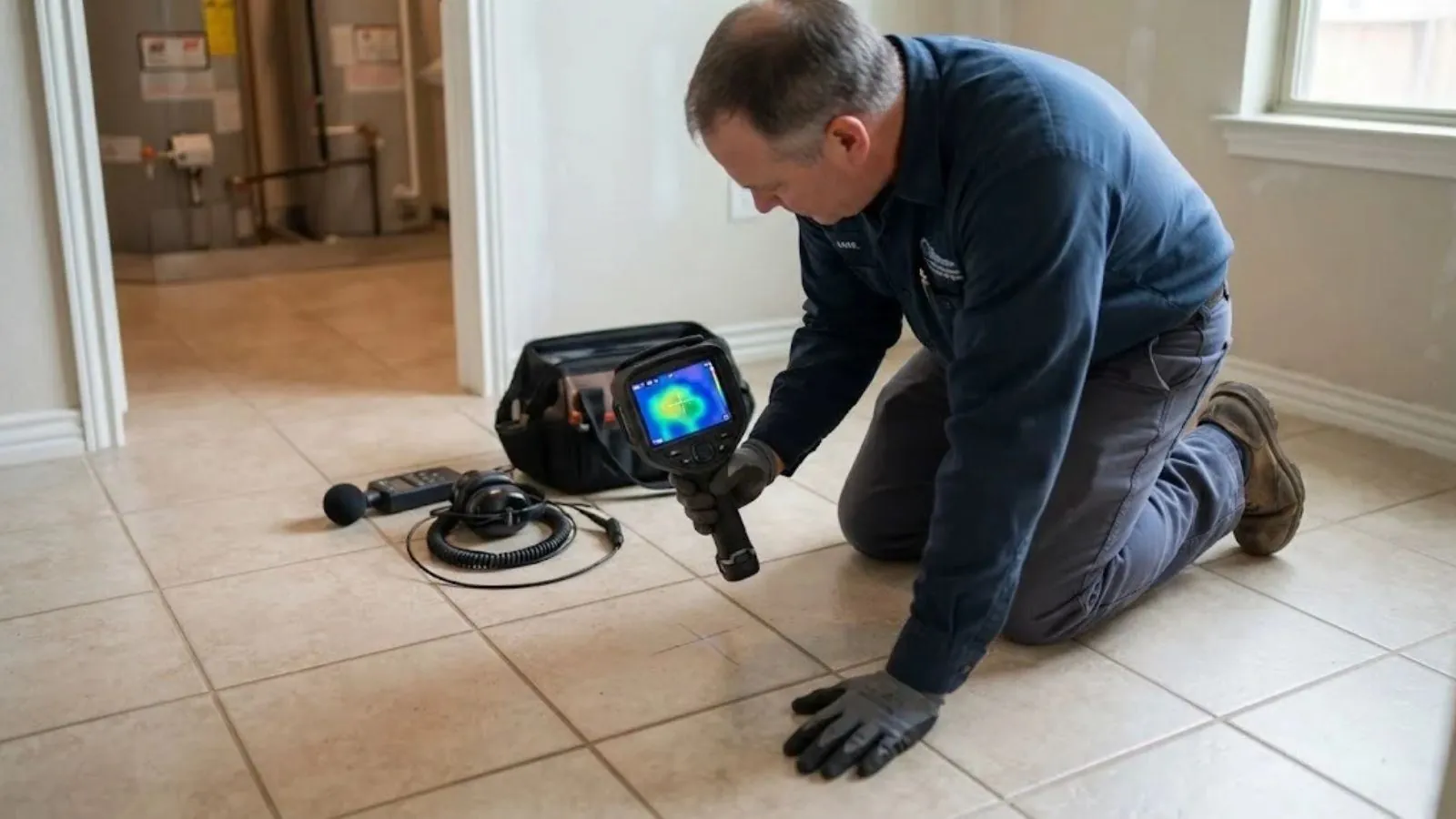
A plumber starts by pressure testing the lines to confirm a leak and to find out which line it is on. Electronic listening equipment, such as a ground microphone, then picks up the sound of escaping water, and a thermal camera can show a warm hot-water line under the floor. Together they allow a precise spot to be marked before any concrete is opened.
That matters because breaking up a slab in the wrong place is expensive and does not stop the leak. Our leak detection work focuses on locating before cutting.
Repair options and their trade-offs
Open the slab and fix the pipe
- Direct repair at the exact spot.
- Involves breaking and patching concrete and flooring.
- Makes sense for a single, clearly located leak.
- Messy and disruptive indoors.
Reroute or repipe above the slab
- Abandons the leaking line and runs new pipe through walls or the attic.
- Less concrete work and avoids repeat leaks in the same line.
- Better when pipe is old or leaks have recurred.
- Higher up-front scope, which a plumber can price clearly.
Park Ridge note: the meter and your bill
The City of Park Ridge's resident FAQ says the City maintains water meters and bills every other month. It also says the city's WaterSmart portal offers free leak alerts. Because bills arrive every two months, a hidden leak can run for weeks before the number looks wrong.
For you, the lesson is to check the meter yourself instead of waiting for a bill, and to sign up for WaterSmart alerts. If the leak is on the pipe between the shutoff box and your house, the city's FAQ puts that water service pipe on the homeowner, which affects who pays for the repair.
What to do right away if you suspect a slab leak
- Run the meter check described above.
- Shut off the main valve if you hear water or see damp flooring.
- Turn off the water heater if the hot line may be involved.
- Move rugs, furniture, and valuables off wet or warm flooring.
- Take dated photos of damage for your insurance file.
- Read your homeowner policy to see what water damage it covers.
- Call a licensed plumber and ask for a clear price before work starts.
Who to call and how fast
Water under a slab keeps flowing day and night, so a suspected slab leak is worth a same-day call when appointments are available. Our line is open 24/7, and we can talk you through shutting off the main. If the leak is outside the house, our water service line repair team handles the pipe between the street and your home.
We serve Park Ridge, Norridge, and Mount Prospect, and many nearby suburbs.
Frequently asked questions
No. Only homes or additions built on a concrete slab. Homes with basements or crawl spaces have exposed pipes. The city's profile does not list foundation types, so check your own house.
You can suspect one from warm spots, sounds, and a moving meter. Pinpointing it takes pressure testing, listening equipment, or a thermal camera, which is what a plumber brings.
Policies differ. Many cover sudden water damage but not the worn pipe itself, and some limit slab access costs. Read your policy and ask your insurer before work starts.
A bad one is. Water under the floor can undermine flooring and run up bills quickly. Shut off the main if you can and call our 24/7 line.
The City's WaterSmart portal offers free leak alerts according to the resident FAQ. Contact the Public Works Service Center to ask how to enroll.
That depends on the lease and who is responsible for the plumbing. Document the leak, tell the tenant, and keep records of the diagnosis. We can provide a written finding.