
Start by naming the water
A basement gets wet in three different ways, and each one has a different cure. Groundwater pushes through the wall or up at the floor joint. Surface water runs toward the house and finds a crack, a window well or a door sill. Sewer water rises through a floor drain or toilet when the public sewer is full.
Exterior waterproofing only addresses the first two, and only when the cause is soil water against the wall. If you see a brown, smelly surge at the floor drain, stop shopping for excavation and read the sewer backup section further down.
Exterior system or interior system
Exterior waterproofing
- Excavate to the footing, clean and coat the wall, then add new perimeter drain tile and stone.
- Stops water before it enters, which also protects the wall itself.
- Needs open ground all around the wall, so patios, porches, decks and landscaping are in the way.
- Digging is heavy work, and it is hard to do beside a neighbor's lot line or a driveway.
- Does not fix a failed sump pump or a sewer backup.
Interior drain and sump
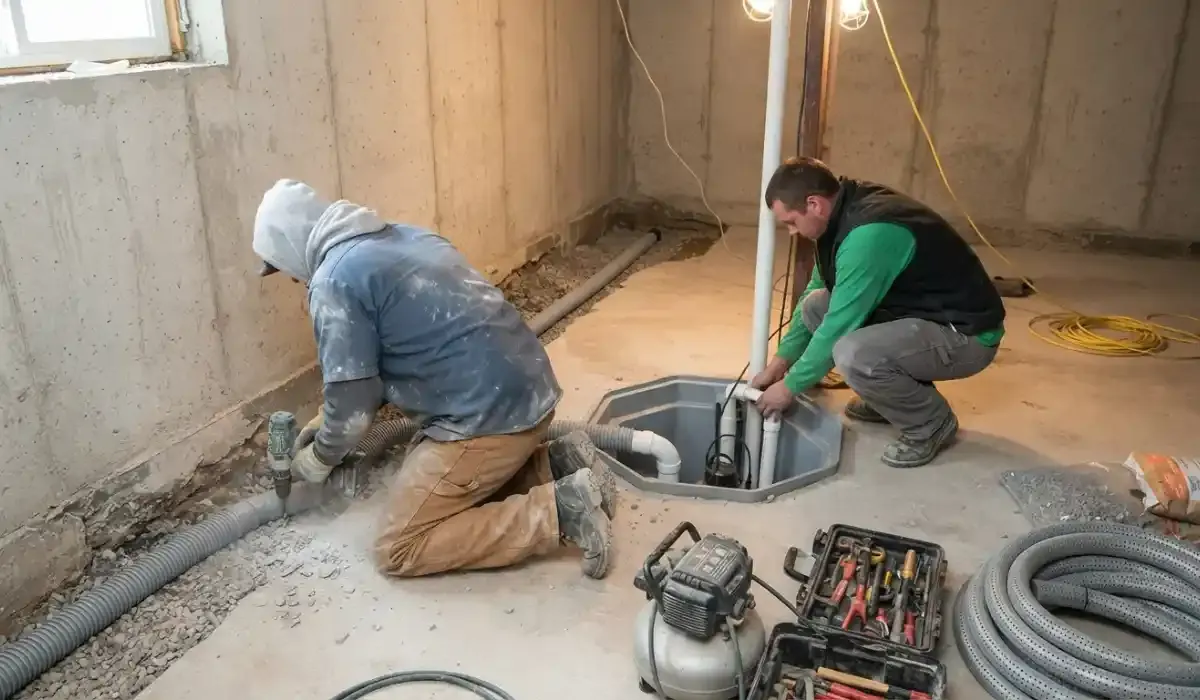
- Cut the floor edge, lay drain pipe in stone, and route water to a sump pit with a pump.
- Works from inside, so the yard stays as it is.
- Handles water that is already under the slab or in the wall block.
- Depends on power and a working pump, so battery backup matters.
- Wall stays wet behind the finish, which matters if you plan to finish the basement.
What the exterior job involves
The crew digs a trench down to the bottom of the foundation wall, often six or more feet. They clean the wall, repair cracks, apply a membrane or coating, and add a dimpled drainage board so water slides down instead of pressing on the wall. At the footing they lay perforated drain tile in washed stone that leads to a sump pit or to daylight.
Then comes backfill, which is where jobs often go wrong. Soil packed too tightly against the wall or graded toward the house will undo good work, so the finished slope should drop away from the foundation.
Need a plumber, not a guide?
Call the 24/7 line. A licensed, insured plumber, a clear price before work starts.
Cheaper fixes to rule out first
Many wet walls come from the surface, not from a failed foundation.
Grade the soil
Soil that dips toward the house channels rain to the wall. Build it up so it falls away from the foundation.
Extend downspouts
A downspout that empties at the wall dumps hundreds of gallons into the ground in a storm. Carry it well past the foundation.
Check window wells
A well with no drain, a cracked liner or a clogged bottom fills like a bucket. Clean it out and cover it.
Seal visible cracks
A single hairline crack can be injected from inside. Watch whether it leaks only after heavy rain.
Symptom, likely cause, next step
Use this as a first sort before anyone digs.
| What you see | Likely cause | What happens next |
|---|---|---|
| Damp patch on one wall after heavy rain | Surface water or a clogged downspout | Fix grade and gutters, then watch the next storm |
| Water at the wall and floor joint | Groundwater pressure | Interior drain and sump, or exterior tile if access allows |
| Water standing in a window well | Blocked or missing well drain | Clear the drain, add a cover, check the liner |
| Sump pit full and pump silent | Pump or power failure | Plumber repairs or replaces the pump and adds backup |
| Dirty water from a floor drain | Sewer backup | Stop using water, call a plumber, see the sewer steps |
Park Ridge note: flood history and what it means for your basement
The Cook County hazard mitigation plan annex for Park Ridge records that nearly 500 basements flooded on July 23, 2011. It also notes that April 2013 flooding was a federally declared disaster (FEMA DR-4116), and that a flash flood on August 7, 2018 caused $100,000 in reported property damage. The plan blames much of the city's urban flooding on its antiquated combination sewer system.
That matters for your decision because a combination sewer can fill during a downpour and push water back into houses, which no wall coating can stop. The city's stormwater page on parkridge.us also links its February 12, 2018 Stormwater Master Plan, including a presentation on overland flooding, plus a page of after-flood cleanup resources. Overland water and sewer water need different fixes, so ask which one hit you before you sign for exterior work.
Who handles what: plumber or waterproofing contractor
| Task | Plumber | Waterproofing contractor |
|---|---|---|
| Sump pit, pump, check valve and battery backup | Yes | Some do |
| Discharge line routing and floor drains | Yes | Some do |
| Sewer backup, cleanout, backwater valve | Yes | No |
| Excavation, wall membrane, exterior drain tile | Usually not | Yes |
| Grading, gutters, window well work | No | Sometimes, or a landscaper |
How a plumber fits in
Most exterior jobs end in a sump pit, and that pit is plumbing. Our licensed plumbers can set the pit, pump and discharge line, which is covered in sump pump repair when an existing pump has failed. A new tile system with a weak pump just moves the flood from the wall to the pit.
We also check whether a floor drain or sewer line is the real entry point. If your basement took water after a storm, the sewer side belongs in the same conversation, and our sewer line cleaning crew can tell you if the main line is clear.
Before you hire anyone to dig
- Note the date, the rain and where the water first appeared.
- Check every downspout and window well on that side of the house.
- Look at the soil slope within six feet of the wall.
- Ask whether the water came from the wall, the floor joint or a drain.
- Get written scope that names the wall coating, drain tile, stone and backfill.
- Ask who pulls permits and what the Park Ridge Building Department needs for the job.
- Confirm who restores the lawn, patio or driveway when digging ends.
Honest limits of exterior waterproofing
No system makes a basement immune to every storm. In a very large rain, groundwater and overland water can overwhelm a wall, and a combination sewer can still back up through drains in the house. If a company promises total protection, ask what it will do when a storm exceeds the design.
For neighbors in towns near ours, the same sorting applies in Des Plaines and Niles. Basements there face the same question first: is it the wall, the pit or the sewer?
Code and permits for exterior waterproofing
Excavation and drain tile are only part of the picture. According to the City of Park Ridge resident FAQ, Article 15 of the Municipal Code requires a permit for all plumbing installations or alterations. Any new connection to a sump, floor drain or sewer line follows the Illinois Plumbing Code, 77 Ill. Adm. Code 890, so get the permit plan in writing.
Frequently asked questions
Not always. Exterior work protects the wall and stops water outside, but it needs open ground and costs more in disruption. An interior drain and sump is often enough when water arrives at the floor edge.
No. Sewer water enters through floor drains, toilets or tubs, not through the wall. A backwater valve or overhead sewer addresses that problem.
Usually yes. New tile has to send water somewhere, and in many houses that is a sump pit. A working pump with backup power is part of the system.
Some plumbing jobs involve digging, such as sewer or water service work. Full foundation waterproofing is generally a waterproofing contractor's trade, though we handle the pit, pump and discharge.
Ask the Building Department which permits your job needs. Rules vary by job, so we confirm with them rather than guess.
No, it means the risk is real enough to plan for. The 2011, 2013 and 2018 events in the hazard plan show why a pump, backup power and a sewer check are worth a look.