
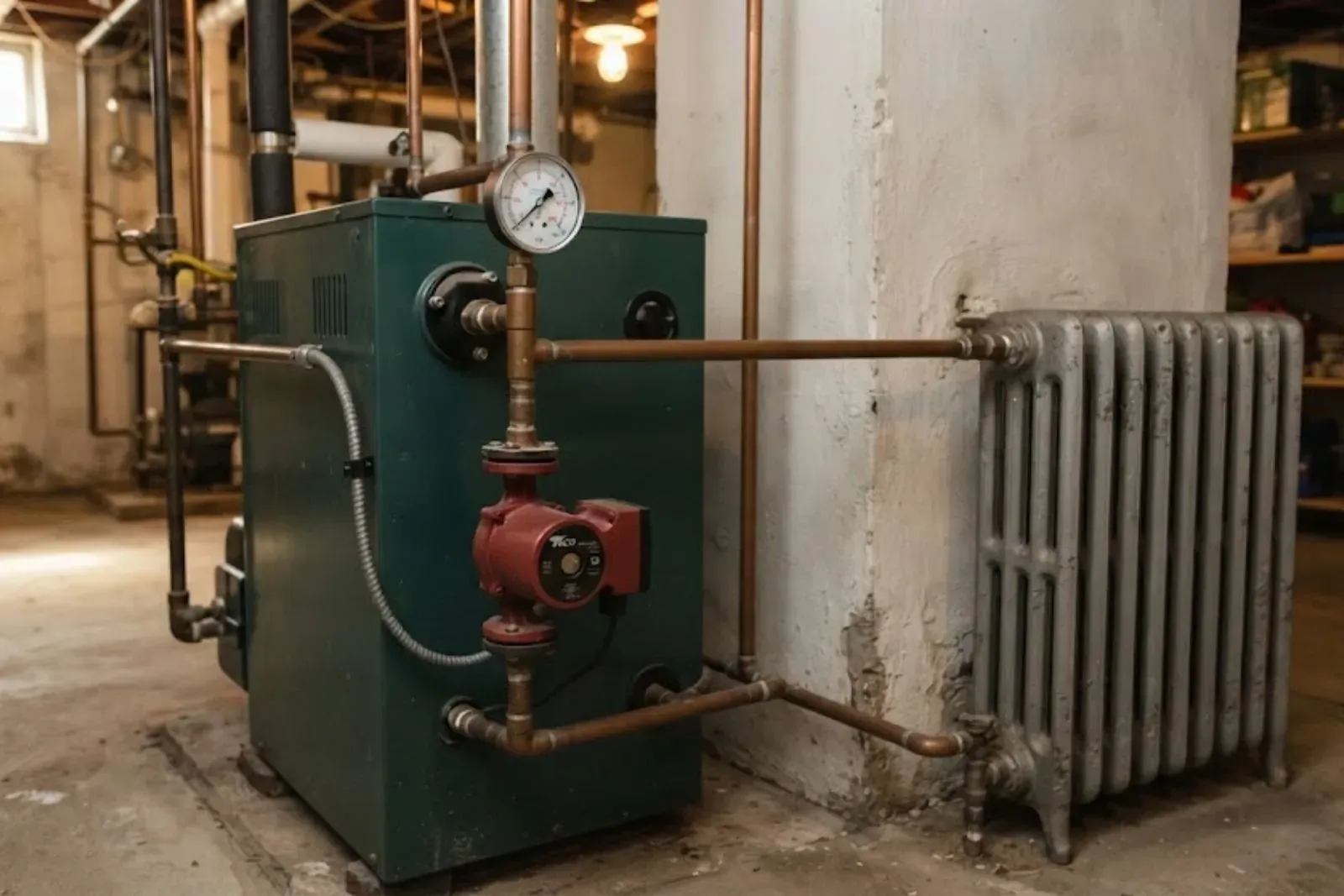
What the tank does inside the heating loop
In a closed hot water heating system, the boiler heats water that circulates through baseboards, radiators or in-floor tubing. When that water goes from cold to hot, it expands. The tank holds an air charge behind a rubber diaphragm or bladder, and the extra water compresses the air.
As the system cools, the air pushes water back out and pressure falls to normal. This cycle repeats every time the boiler fires, which is why a tank with no air cushion causes trouble fast.
Signs the tank has failed
| What you notice | What it suggests | Next step |
|---|---|---|
| Pressure shoots up whenever the boiler heats | Tank waterlogged or air charge lost | Have a pro check the tank and fill pressure |
| Relief valve drips or discharges | Pressure reached the valve's limit | Do not cap the valve, call for service |
| Boiler cycles on and off quickly | System has no cushion for expansion | Inspect the tank and controls |
| Tank feels full and heavy all over | Diaphragm has ruptured | Replace the tank |
| Water at the tank valve or air valve | Failed bladder or corroded shell | Replace the tank |
Pressure behavior to watch
A healthy system sits at a stable cold pressure and rises modestly when hot. Check the gauge when the boiler is cold, then again at full temperature. The cold fill value is often marked on the boiler or in its manual, so read it before judging.
If pressure jumps well above that figure, or the needle swings up on each cycle, the tank is the first suspect. If the gauge sits near zero, the system has lost water, which is a leak or auto-fill issue and a different problem.
Need a plumber, not a guide?
Call the 24/7 line. A licensed, insured plumber, a clear price before work starts.
Relief valve discharge: do not ignore it
The relief valve is the safety device that opens when pressure gets too high. Residential boiler valves are often rated near 30 psi, but check the label on yours. A dripping valve means pressure is reaching that limit, so find the cause instead of replacing the valve alone or capping the line. Hot discharge can scald, so keep clear of the outlet pipe.
Repair, replace or recharge
Recharge or adjust
- Works only when the tank is a healthy diaphragm type and has lost some air.
- Done with the system cold and isolated, using a tire gauge on the air valve.
- Cheap in parts, but it only helps if the diaphragm is intact.
- Water coming out of the air valve means the diaphragm is gone.
Replace the tank
- Right choice when the tank is waterlogged, rusted or leaking.
- Needs isolating and draining part of the loop, then purging air.
- Sized for the system volume and set to the cold fill pressure.
- A good time to check the relief valve, the feeder and the air separator.
How a service visit goes
Read pressure
The tech notes cold and hot pressure and checks the relief valve and the fill line.
Test the tank
Tapping and pressing the air valve shows whether the tank is full of water.
Isolate
With the system cold, the loop is isolated and the pressure relieved before work.
Charge and purge
The new tank is charged to match fill pressure and air is bled from the system.
Before you call
- Note the cold pressure and the pressure when the boiler is hot.
- Look at the relief valve outlet for drips or stains.
- Check the tank for wetness at the air valve or a hot, heavy feel.
- Smell for gas, and if you do, leave and call the gas utility from outside.
- Photograph the boiler label showing model and rated pressure.
- Write down when the problem began and what changed.
Plumber or heating contractor
Hydronic boilers sit between plumbing and heating. Piping, valves, tanks, feeders and relief lines are plumbing work, while burners, controls and gas train are heating work. Some companies handle both, and others split them.
Ask whoever you call whether they service hydronic boilers and both the water side and the burner. A tank swap and pressure adjustment is often within a plumber's scope, while a combustion or control fault may need a heating specialist. Our licensed plumbers can look at the water side and tell you where the problem sits.
Park Ridge note: winters and permits
The Cook County hazard mitigation plan annex for Park Ridge notes that winter storms can bring more than 10 inches of snow, and Wikipedia lists the area in USDA Plant Hardiness Zone 5b. For you, that means a heating failure on a cold night is more than an inconvenience, so a tank issue is worth fixing before January.
The city FAQ on parkridge.us says Article 15 of the Municipal Code requires a permit for plumbing installations or alterations. Permit rules vary by job, so we confirm with the Park Ridge Building Department before a larger boiler replacement. A simple tank swap may be treated differently from a full boiler replacement, and new piping work falls under plumbing installation, which is why we ask.
Nearby towns
We hear the same tank and pressure symptoms from homes in Niles and Norridge, where older hydronic systems are common. The advice is the same anywhere. Do not keep adding water to chase pressure, and have the tank checked.
Code and licensing for boiler work
Boiler work mixes plumbing and heating trades. Plumbing connections follow the Illinois Plumbing Code, 77 Ill. Adm. Code 890, and according to the Illinois Department of Public Health, plumbers are licensed under the Illinois Plumbing License Law. Ask who is licensed for each part before you book.
Frequently asked questions
Many last for years, but a diaphragm can fail at any time and a steel shell can rust. Treat any pressure swing or water at the air valve as a replacement signal.
Only a diaphragm tank can be recharged, and only with the system cold and the tank isolated. If water spits from the air valve, stop, because the diaphragm has failed.
Pressure is reaching the valve's limit, often from a failed expansion tank, an over-filled system or a bad feeder. A worn valve can also drip, so have the whole system checked.
It raises pressure and can discharge hot water from the relief valve, which can scald. Keep clear and call for service instead of capping the valve.
They work on the same idea but belong to different systems. A boiler tank serves the closed heating loop, while a water heater tank serves the domestic water line.
The city FAQ says Article 15 requires a permit for plumbing installations or alterations, and rules vary by job. We confirm with the Building Department before work.
Yes, our line runs 24/7, and we offer same-day appointments when available. A relief valve discharging in cold weather is worth calling about right away.